Microfluidic Device Tests Fluid Compatibility
Apr 14, 2006
Microfluidic Device Tests Fluid Compatibility
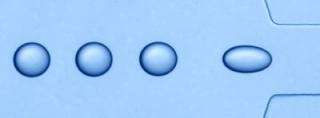
A new NIST microfluidic instrument measures the mixing compatibility of complex liquids by observing how drops of one fluid flowing within a "river" of a second fluid change in shape as they travel through channels of various sizes. Credit: Credit line: S.Hudson/NIST

The key to a great party is inviting guests who mix well and don't instill tension among their fellow revelers. The key to a great detergent, cosmetic, paint or other complex liquid product is pretty much the same--include components that mix well and don't have high levels of what scientists call "interfacial tension," a tendency to bead up and pull away from each other.

To help industrial engineers improve their ability to systematically test new product formulations, researchers at the National Institute of Standards and Technology (NIST) have developed a microfluidic instrument that quickly measures interfacial tension.

The instrument is relatively simple and includes a series of channels ranging from 700 micrometers to 50 micrometers wide. Fluids are pumped toward a "T" intersection where drops of one liquid are pinched off and flow along a "river" of the second liquid. As the spherical drops flow through constriction points in the channel, they speed up and elongate. The degree to which the drops stretch out depends on the interfacial tension between the two fluids. High levels of tension exert more pressure on the drops, keeping them more nearly spherical.

Just as the mood of a party goes through stages, the tension between newly mixed liquids can change over time, and the device tracks these changes as the drops move downstream through the channel. A camera captures 100 pictures per second to record the changes, and an algorithm analyzes the data and produces a measurement in approximately 1 second.

Reporting on their work in the March issue of the journal Lab on a Chip, the researchers say they expect that the device will be especially useful to test fresh interfaces for applications with scarce amounts of the fluids to be tested such as custom-synthesized materials from combinatorial chemistry.

Source: NIST

Explore further: Physicists develop revolutionary low-power polariton laser

add to favorites email to friend print save as pdf

Related Stories

How 'transparent' is graphene?

Dec 03, 2012

The amazing electrical, optical and strength properties of graphene, a single-atom-thick layer of carbon, have been extensively researched over the last decade. Recently, the material has been studied as ...

How to make a splash

May 09, 2012

(Phys.org) -- A team of physicists has used the high-energy x-rays of the Advanced Photon Source (APS) at Argonne National Laboratory to penetrate the everyday mystery of a splash, revealing previously hidden ...

Recommended for you

Lab sets a new record for creating heralded photons

15 hours ago

(Phys.org) —Entanglement, by general consensus of physicists, is the weirdest part of quantum science. To say that two particles, A and B, are entangled means that they are actually two parts of an inseparable ...

Breakthrough calls time on bootleg booze

22 hours ago

(Phys.org) —Using a laser, the St Andrews scientists can now carry out detailed analysis of a spirit sample no bigger than a teardrop and can even confirm whether it is toxic or not. It's hoped the testing ...

Competition in the quantum world

May 20, 2013

Innsbruck physicists led by Rainer Blatt and Peter Zoller experimentally gained a deep insight into the nature of quantum mechanical phase transitions. They are the first scientists that simulated the competition ...

Promising doped zirconia

May 17, 2013

Materials belonging to the family of dilute magnetic oxides (DMOs)—an oxide-based variant of the dilute magnetic semiconductors—are good candidates for spintronics applications. This is the object of ...

User comments : 0

More news stories

Lab sets a new record for creating heralded photons

(Phys.org) —Entanglement, by general consensus of physicists, is the weirdest part of quantum science. To say that two particles, A and B, are entangled means that they are actually two parts of an inseparable ...

Breakthrough calls time on bootleg booze

(Phys.org) —Using a laser, the St Andrews scientists can now carry out detailed analysis of a spirit sample no bigger than a teardrop and can even confirm whether it is toxic or not. It's hoped the testing ...