Could Reducing Global Dimming Mean a Hotter, Dryer World?
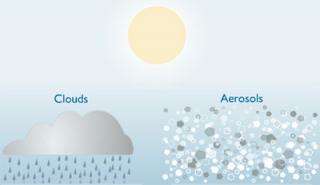
Despite concerns over global warming, scientists have discovered something that may have actually limited the impact of greenhouse gases in the atmosphere in recent years by reducing the amount of sunlight reaching the surface of the Earth. So-called "global dimming," will be the focus of a NOVA special scheduled to air on April 18 and featuring Lamont-Doherty researcher Beate Liepert.
In research they published last year in the journal Geophysical Research Letters, a team led by Beate Liepert at the Lamont-Doherty Earth Observatory reported that they found a measurable decline between 1950 and 1990 in the amount of sun reaching the Earth's surface. The team concluded that solar radiation is being reduced by growing quantities of man-made particles in the atmosphere—in particular those produced by burning fossil fuels. This increase in small particles of ash, soot and sulfates has also caused the cloud cover to thicken in recent decades, further reducing solar irradiance. Only recently have climate models begun to include them in predictions of future global warming.
"Aerosols are highly variable in space and time, which is why aerosol forcing of climate is generally very difficult to include in climate studies," said Liepert. "Furthermore, aerosols are found near the Earth's surface and affect mainly the fluxes of energy and water at the surface. These new ideas on the affects of aerosols might open up many avenues and solve more discrepancies in the climate change debate."
It is widely agreed that greenhouse gasses in the atmosphere are causing temperatures to rise around the world. What has not been considered until recently is how temperatures would respond if the aerosol layer and cloud cover were not reflecting some of the suns radiation away from the planet. Liepert and her co-authors also concluded that the imbalance between a decline in solar radiation and warming surface temperatures will lead to weaker turbulent heat fluxes and reduced evaporation and precipitation, which could ultimately lead to a more humid atmosphere in which it rains less.
Although rising temperatures should increase the amount of moisture in the atmosphere, the research shows that human-produced airborne aerosols can cause water to condense to form more, but smaller, cloud droplets. This process is likely contributing to the observed thickening of the Earth's cloud cover. However, smaller droplets are not heavy enough to sink through the air as rain. As a result, the cloud cover lasts longer and there is less rain.
"Water has a characteristic residence time in the atmosphere before it gets rained out. In a warmer world, this residence time is longer because a warmer atmosphere can hold more water," said Liepert. "Aerosols affect clouds by suppressing rain and increasing its residence time."
Examples of data supporting this new hypothesis include studies indicating a steady decline of water evaporation in the Northern Hemisphere over the past 50 years. Over the last 60 years, large regions of Eurasia have seen soil moisture increase by more than one centimeter per decade, yet no significant changes in precipitation are being seen.
Global dimming also resulted in an observable difference in the brightness of sunlight. Even in remote areas, the atmosphere was more polluted and therefore darker. In the end, successful efforts to reduce emissions and clean up air pollution around the world could cause the full effect of global warming to become more noticeable in the near future.
"We thought we live in a global warming world, but this is actually not right," Liepert said in a BBC interview last year. "We lived in a global warming plus a global dimming world and now we are taking out global dimming. So we end up with the global warming world, which will be much worse than we thought it will be, much hotter."
Source: The Earth Institute at Columbia University


