Museum unveils world's largest T-rex skull
Apr 07, 2006
Museum unveils world's largest T-rex skull
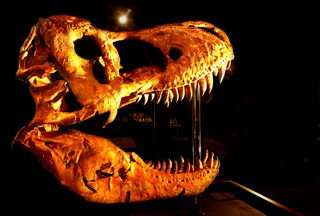
Measuring 5 feet across, a T. rex skull found 40 years ago in Montana is the world´s largest T. rex skull. The specimen is now on display at the Museum of the Rockies at MSU. (Museum of the Rockies photos by John Little)

The world's largest Tyrannosaurus rex skull, unearthed nearly 40 years ago in eastern Montana, is now on display at the Museum of the Rockies at Montana State University in Bozeman.

The skull measures 5 feet long, making it bigger than the previous record-holder--the T-rex named "Sue" at Chicago's Field Museum, according to Jack Horner, the Museum's curator of paleontology.

Skull fragments from the specimen, known as MOR 008, were found in the Hell Creek Formation near Billings in the late 1960s and collected by Bill McMannis, an MSU geologist. Museum preparator Carrie Ancell began their reconstruction in the late 1980s, and preparator Michael Holland finished the job this year.

A single vertebra is the only other piece of MOR 008 that has been found besides the skull.

"We are going to try and figure out how old the animal was when it died by using histology, the study of the microscopic structure of fossil remains," Horner said. "The specimen contains several characteristics that suggest this individual was mature, and perhaps quite old when it died."

Horner said research on the specimen will continue.

MOR 008 is one of three T-rex skulls in the Museum of the Rockies collection, all of which are on display in the Hall of Horns and Teeth. All of them were found in Montana. The Museum has part of twelve T-rexes, more than any other institution in the world.

The Museum of the Rockies is open from 9 to 5, Monday through Saturday, and 12:30 p.m. to 5 p.m. on Sundays through May 26. Summer hours begin May 27 when the Museum will be open from 8 a.m. to 8 p.m. daily through Labor Day.

For more information visit museumoftherockies.org

Source: Montana State University

Explore further: Fossil brain teaser: New study reveals patterns of dinosaur brain development

add to favorites email to friend print save as pdf

Related Stories

New study reveals North America's biggest dinosaur

Dec 07, 2011

(PhysOrg.com) -- New research from Montana State University's Museum of the Rockies and the State Museum of Pennsylvania has unveiled enormous bones from North America's biggest dinosaur.

New raptor dinosaur takes a licking keeps on ticking

Sep 19, 2011

Raptor dinosaurs like the iconic Velociraptor from the movie franchise Jurassic Park are renowned for their "fear-factor." Their terrifying image has been popularized in part because members of this group possess a greatly ...

Recommended for you

Relaxed tourists share more

5 hours ago

Tourists set on relaxing and socialising when they reach their holiday destination tend to do little advance research on the internet before making their trip, but are more likely to share travel information and photos on ...

Tiny ancient bandicoot shines light on future

7 hours ago

(Phys.org) —A 20 million-year-old fossil skull identified as a 'pocket-sized' ancestor of the bandicoot will give insights into the future of Australia's modern endangered animals.

Daylight Saving Time spurs drop in crime rate

7 hours ago

(Phys.org) —Researchers are no longer in the dark about when criminals are most likely to attack. William & Mary economist Nicholas Sanders teamed up with the University of Virginia's Jennifer Doleac to study the connection ...

User comments : 0

More news stories

Tiny ancient bandicoot shines light on future

(Phys.org) —A 20 million-year-old fossil skull identified as a 'pocket-sized' ancestor of the bandicoot will give insights into the future of Australia's modern endangered animals.

Relaxed tourists share more

Tourists set on relaxing and socialising when they reach their holiday destination tend to do little advance research on the internet before making their trip, but are more likely to share travel information and photos on ...

Daylight Saving Time spurs drop in crime rate

(Phys.org) —Researchers are no longer in the dark about when criminals are most likely to attack. William & Mary economist Nicholas Sanders teamed up with the University of Virginia's Jennifer Doleac to study the connection ...

Protein study suggests drug side effects are inevitable

A new study of both computer-created and natural proteins suggests that the number of unique pockets – sites where small molecule pharmaceutical compounds can bind to proteins – is surprisingly small, meaning drug side ...

Do salamanders hold the solution to regeneration?

Salamanders' immune systems are key to their remarkable ability to regrow limbs, and could also underpin their ability to regenerate spinal cords, brain tissue and even parts of their hearts, scientists have ...