Norwegian glaciers could melt completely
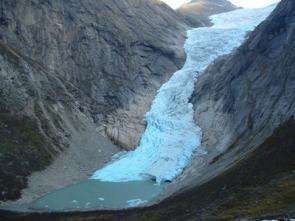
Climate researchers predict that the approximately 1,600 Norwegian glaciers could melt completely away in course of the next 100 years. This would mean that only 28 glaciers would remain in the country.
The background for this prediction comes from new calculations from the Norwegian climate programme RegClim. They have developed a new “long-term outlook” for Norway, in which they calculate that the average temperature in summer will rise by 2.3 degrees Celsius.
Researchers at The Bjerknes Centre for Climate Research at the University of Bergen have estimated the consequences of this for Norwegian glaciers. They have presented the results in the most recent edition of the climate journal Cicerone.
"It’s even more dramatic than we expected,” says professor Atle Nesje.
By the reckoning of the University of Bergen researchers, about 1,600 Norwegian glaciers will melt completely. This amounts to 98 percent of the total Norwegian glaciers, and includes all glaciers smaller than 8 square kilometres. Of the 34 largest glaciers, 11 will disappear completely. The total glacial volume will shrink by about a third, exactly the equivalent of Norway’s largest lake, Mjøsa. The glacial area will also shrink by a third – 2.4 times the area of Mjøsa.
"Perhaps this doesn’t sound like so much if you compare it with the difference in temperature of a cold winter day and a warm summer day. But over time, an average temperature rise of 2.3 degrees is dramatic, explains Nesje.
This can be compared to the period just after the most recent ice age.
The largest glaciers can disappear in less than 100 years
"From 6,000 to 8,000 years ago the average temperature was 1.5 to 2 degrees Celsius higher than today. During this period, all the glaciers in Norway melted completely," he says.
Researchers have determined this by analysing sediment at the bottom of lakes. As long as the water source is melted glacier, the sediment is largely made up of sand and gravel. Once the glaciers are gone, the sediment is made up exclusively of plants. Researchers have also established that once the melting begins it can proceed quickly.
"It will go very quickly this time. It can happen in less than 100 years,” explains Nesje.
The water bank is lost
If the researchers are correct, it will first be the water volume in rivers that will be noticeable. After the snow has melted in the spring, it is the glacial melting that contributes to the water volume, along with precipitation. Rain comes in fits and starts, but glacial melting provides even water levels during fair weather. Glaciers function as a water bank that is crucial for both Norwegian environment and society.
"If we lose the glaciers, we lose the bank,” explains Nesje. If waterfalls depend on rainfall, it’s obvious that tourism will be hurt. Farming can also be vulnerable. Additionally, an even flow of river water is absolutely necessary to maintain a stabile environment in our fjords.
"Most of today’s glaciers have existed for 4,000 to 6,000 years. The ecosystem in rivers and fjords have developed over a long period and are sensitive. We will experience that many species will die out, while new ones will develop," says Nesje.
Consequences must be planned for now. Nesje underscores that climate changes resulting in dramatic consequences such as this are no doubt man-made.
"The international research community agrees: This goes beyond what can be attributed to natural swings. This is a man-made component on top of the whole. This will no doubt be emphasised when the UN’s climate panel releases its next report," he assures.
Temperature changes that will come in the next 100 years is probably already to late to stop. This doesn’t mean we should just wait for warmer times with our hands in our pockets.
"We must begin to plan for the consequences. Primarily, we must study what it will mean for farming, energy production, tourism, fishing and what glacial water means for the ecological condition in general," says Nesje.
Source: Research Council of Norway


