Spitzer and Deep Impact Build Recipe for Comet Soup
When Deep Impact smashed into comet Tempel 1 on July 4, 2005, it released the ingredients of our solar system's primordial "soup." Now, astronomers using data from NASA's Spitzer Space Telescope and Deep Impact have analyzed that soup and begun to come up with a recipe for what makes planets, comets and other bodies in our solar system.
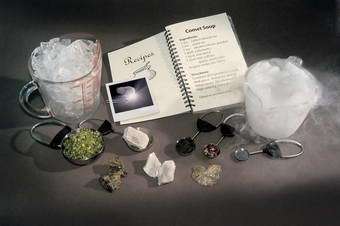
Image: Hungry for a comet? Perhaps not, but astronomers using data from NASA's Spitzer Space Telescope and the Deep Impact mission are putting together a recipe for comet "soup" - the primordial stuff of planets, comets and other bodies in our solar system.
"The Deep Impact experiment worked," said Dr. Carey Lisse of Johns Hopkins University's Applied Physics Laboratory, Laurel, Md. "We are assembling a list of comet ingredients that will be used by other scientists for years to come." Lisse is the team leader for Spitzer's observations of Tempel 1. He presented his findings this week at the 37th annual meeting of the Division of Planetary Sciences in Cambridge, England.
Spitzer watched the Deep Impact encounter from its lofty perch in space. It trained its infrared spectrograph on comet Tempel 1, observing closely the cloud of material that was ejected when Deep Impact's probe plunged below the comet’s surface. Astronomers are still studying the Spitzer data, but so far they have spotted the signatures of a handful of ingredients, essentially the meat of comet soup.
These solid ingredients include many standard comet components, such as silicates, or sand. And like any good recipe, there are also surprise ingredients, such as clay and chemicals in seashells called carbonates. These compounds were unexpected because they are thought to require liquid water to form.
"How did clay and carbonates form in frozen comets?" asked Lisse. "We don't know, but their presence may imply that the primordial solar system was thoroughly mixed together, allowing material formed near the Sun where water is liquid, and frozen material from out by Uranus and Neptune, to be included in the same body."
Also found were chemicals never seen before in comets, such as iron-bearing compounds and aromatic hydrocarbons, found in barbecue pits and automobile exhaust on Earth.
The silicates spotted by Spitzer are crystallized grains even smaller than sand, like crushed gems. One of these silicates is a mineral called olivine, found on the glimmering shores of Hawaii's Green Sands Beach.
Planets, comets and asteroids were all born out of a thick soup of chemicals that surrounded our young Sun about 4.5 billion years ago. Because comets formed in the outer, chilly regions of our solar system, some of this early planetary material is still frozen inside them.
Having this new grocery list of comet ingredients means theoreticians can begin testing their models of planet formation. By plugging the chemicals into their formulas, they can assess what kinds of planets come out the other end.
"Now, we can stop guessing at what's inside comets," said Dr. Mike A'Hearn, principal investigator for the Deep Impact mission, University of Maryland, College Park. "This information is invaluable for piecing together how our own planets as well as other distant worlds may have formed."
NASA's Jet Propulsion Laboratory, Pasadena, Calif., manages the Spitzer Space Telescope mission for NASA's Science Mission Directorate, Washington. Science operations are conducted at the Spitzer Science Center at Caltech. The University of Maryland, College Park, conducted the overall mission management for Deep Impact, and JPL handled project management for the mission for NASA's Science Mission Directorate.
Source: NASA


