Mega eruption of Yellowstone's southern twin
North America isn't the only continent that's experienced super-colossal volcanic eruptions in the recent geologic past. The massive explosion of the almost unknown Vilama Caldera in Argentina appears to have matched Yellowstone's last continent-blanketing blast. It may, in fact, be just one of several unappreciated supervolcanoes hidden in a veritable mega-volcano nursery called the Eduardo Avaroa Caldera Complex, located in the inhospitable Puna-Altiplano region near the tri-section of Argentina, Bolivia, and Chile.
"Vilama Caldera formed during a single event that emitted approximately 2000 cubic kilometers (almost 500 cubic miles) of pyroclastic material," said geologist Miguel M. Soler of the National University of Jujuy in San Salvador de Jujuy, Argentina. The volume of ash and pyroclastic material, called ignimbrites, produced by the 8.4 million-year-old eruption, and the size of the associated caldera, put it among the world's largest known eruptions, he says.
"In contrast, for example, Yellowstone produced its important volumes of ignimbrites and lavas in three cataclysmic events. Eruptions at 2.0, 1.3, and 0.6 million years ago ejected huge volumes of rhyolite magma, and each formed a caldera and extensive layers of thick pyroclastic flow deposits," said Soler. Soler will present some of the recent groundbreaking work on Vilama supervolcano on Monday, 3 April 3 at Backbone of the Americas - Patagonia to Alaksa. The meeting is co-convened by the Geological Society of America and the Asociación Geológica Argentina, with collaboration of the Sociedad Geológica de Chile. The meeting takes place 3-7 April in Mendoza, Argentina.
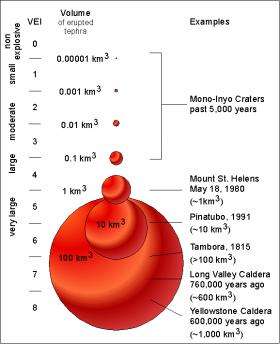
The Vilama Caldera appears to have been created when the 10 by 24-mile roof catastrophically collapsed on a chamber of molten rock, or magma, explosively venting vast amounts of ignimbrites out in various directions. That massive roof collapse is the one thing all large calderas have in common and what separates them from the exponentially smaller "single vent" volcanic eruptions like Mount St. Helens or Mount Pinatubo.
But that's where the similarities with Yellowstone end, says Soler. The magma under Yellowstone is thought to be created by the melting of ancient crust under North America, buoying back up and creating a hot spot. Vilama's magma was probably created by a more complex melting of the crust caused by the South American Plate colliding with and overriding the Nazca Plate to the west. The resulting kneading of the crust -- the thickening and thinning, pressurizing and depressurizing -- caused large pockets of rock to melt and eventually led to a series of gigantic caldera eruptions.
The trigger for the Vilama mega-eruption, says Soler, was probably the same thing that gave the caldera its football-like shape: The tectonic faults in the roof of the magma chamber which probably formed as a consequence of its own instability and/or from the significant stresses in the crust in that area. The crystal-rich nature of the ignimbrites and minimal signs of pre-eruption gases also point to an external trigger for the vast eruption, says Soler.
Much remains unknown about Vilama Caldera, says Soler, largely because it is a terribly difficult caldera to study. Unlike Yellowstone, which has the Yellowstone River cutting through it and exposing the layers of volcanic rock, called stratigraphy, for easy reading by geologists, Vilama is in one of the driest places on Earth.
"There is not much topographic relief to permit viewing of many complete columns of stratigraphy," said Soler. What's more, most of the region is more than 13,000 feet above sea level, which makes field work in the area particularly physically demanding, as well. All this also explains why Vilama is just the first of several important calderas in the region that deserve a lot more scientific attention, he said.
"Among the other calderas in the region that need to be studied in detail and which in all cases are also certainly 'supervolcanoes' are Cerro Guacha, Coruto, Pastos Grandes, and Capina," said Soler.
The study of these supervolcanoes is not an end in itself, according to Soler. Figuring out their histories and how and why they erupted will help geologists grasp the regional forces that have been at work in one of the Earth's thickest patches of crust, as well as give clues to other calderas worldwide.
Source: Geological Society of America


