Nanonutrients' Promise: Vast Gains In Human Health
Mar 28, 2006
Nanonutrients' Promise: Vast Gains In Human Health
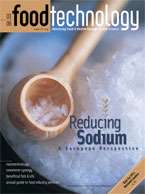
Cover of the March issue of Food Technology magazine, published for 60 years by the non-profit Institute of Food Technologists.

The emerging discipline of nanotechnology holds the promise of improving functional foods and the capability of delivering healthful food compounds to the body where it can utilize them best. This is according to the latest issue of Food Technology magazine.

Remarkable achievements in nanotechnology—the science, engineering and technology of controlling matter one-billionth a meter in size—show great potential for positively influencing human health, the article states. By enhancing solubility, improving bioavailability, and facilitating the controlled release and protecting the stability of micronutrients in food products, nanotechnology could be a successful method to design smart food systems able to target specific systems within the body and their functions.

The report cites current applications that allow nanoscale food components to be encapsulated and mixed with other foods in novel combinations. In some instances it means now being able to dissolve in water compounds like vitamins, antioxidants and healthy oils that usually are not water-soluble. In some instances, nanoscale particles are so small that they’re clear, expanding their potential for use in a wide variety of products.

The article notes that nanoparticles are excellent for rapidly delivering high concentrations of healthy, active ingredients directly to cell membranes. On the other hand, the article highlights that nanoscale adhesive properties may be used to bind to harmful matter and remove potentially harmful compounds from the digestive tract.

Published by the international not-for-profit Institute of Food Technologists and advancing food and health through sound science, Food Technology provides news and analysis of the development, use, quality, safety, and regulation of food sources, products, and processes.

Food Technology is accessible online at www.ift.org/foodtechnology.

Source: Institute of Food Technologists

Explore further: Researchers manipulate cubic zirconia to improve conductivity in fuel cells

add to favorites email to friend print save as pdf

Related Stories

Google boosts photo offerings to rival Facebook

May 16, 2013

Google is digging deeper into its technology toolkit to turn its social networking service into a more formidable threat to Facebook, sprucing up its photo features at a time when sharing snapshots online ...

Glove shows its true colors

May 15, 2013

Security takes top priority in laboratories and in production. In the future, employees exposed to risks will only have to put on a glove in order to receive a toxic substance warning: This textile identifi ...

Keeping fruit, vegetables and cut flowers fresh longer

May 15, 2013

New technology offers the promise of reducing billions of dollars of losses that occur each year from the silent, invisible killer of fruits, vegetables and cut flowers—a gas whose effects are familiar to everyone who has ...

Olive oil assays may help assure authenticity

May 10, 2013

Though the price makes you wince, you might just buy that bottle of your favorite olive oil anyway. Perhaps it's exactly what you want for the salad dressing you're making tonight and for your special stir-fry ...

Recommended for you

Scientists develop cheaper, more efficient fuel cells

6 hours ago

(Phys.org) —Using the Canadian Light Source (CLS) synchrotron, researchers have discovered a way to create cheaper fuel cells by dividing normally expensive platinum metal into nanoparticles (or even single ...

Weird science: Crystals melt when they're cooled

13 hours ago

(Phys.org) —Growing thin films out of nanoparticles in ordered, crystalline sheets, to make anything from microelectronic components to solar cells, would be a boon for materials researchers, but the physics ...

User comments : 0

More news stories

Scientists develop cheaper, more efficient fuel cells

(Phys.org) —Using the Canadian Light Source (CLS) synchrotron, researchers have discovered a way to create cheaper fuel cells by dividing normally expensive platinum metal into nanoparticles (or even single ...

Weird science: Crystals melt when they're cooled

(Phys.org) —Growing thin films out of nanoparticles in ordered, crystalline sheets, to make anything from microelectronic components to solar cells, would be a boon for materials researchers, but the physics ...

Controlling mood through the motions of mitochondria

(Medical Xpress)—Regulating the distribution of power in neurons is done by a system that makes the national electric grid look simple by comparison. Each neuron has several thousand mitochondria confined ...

Google Drive sports new view and scan enhancements

(Phys.org) —Google Drive has a new look and functions. The makeover in Google Drive features scanning and interface enhancements that put the user into "card" mode. The enhancements make it easy for the ...