Stopping light in quantum leap
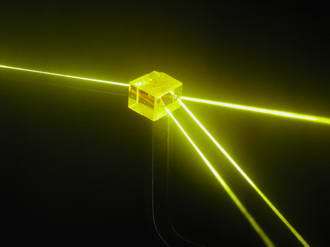
ANU researchers have used a groundbreaking approach to set a world record for stopping light - a crucial step in the development of the next generation of computers.
Lasers passing through the crystal. Image credit: Dr. Matthew Sellars, Laser Physics Centre, ANU.
Researchers from the Laser Physics Centre in the Research School of Physical Sciences and Engineering used a modified crystal to ‘stop’ light for over a second, more than 1000 times longer than earlier attempts.
Dr Matthew Sellars said the team are working to develop memory for quantum computing, a new way of storing and processing information that would be drastically faster and more powerful than existing computers.
“Stopping light is not just a neat trick, it is the basis of a quantum memory — a device capable of storing and recalling the quantum states of light. This is one of many quantum computing components under development in our lab,” Dr Sellars said.
“Light is very good at transmitting information. The only trouble is it’s very, very fast. You need to hold it for a while, or otherwise it just zips off. What we’re trying to do here is store that quantum information by transferring it to quantum states of a crystal, where we can hold it for a very long time.”
“We use a small silicate crystal doped with a rare-earth element, praseodymium. It is on the praseodymium ions that we store the light pulse.
“When we shine a laser pulse at this crystal, it’s normally absorbed. The light doesn’t get through the crystal. Then we add a second laser beam that turns on the coupling between the nuclear spins and the light. This coupling makes the crystal transparent. So when we now fire the first laser beam at it, it gets through, but the odd thing about it is that it takes a very long time to do so.”
Using this method, the researchers have slowed the speed of light down from 300,000 kilometres per second to a few hundred metres per second.
“To store the light in there, we turn the second laser beam off. The signal from the first laser beam is trapped inside the crystal. To get the signal out again, we turn the coupling beam on again. We can now store light for seconds, and potentially quite a bit longer,” Dr Sellars said.
The team are now trying to refine the process so they can store a single photon, which will require a larger crystal, ten times the size of the one currently in use. Co-researcher Dr Jevon Longdell says setting a new world record for stopping light has been a major victory.
“We have gone out on a limb pursuing our unique approach to quantum computing. What our new record shows is that we are on the right track,” Dr Longdell said. “Now, if we can store a single photon we will have demonstrated the world’s first quantum memory.”
Source: Australian National University


