NASA rescheduled MESSENGER start to Mercury to August 3
Aug 02, 2004
NASA rescheduled MESSENGER start to Mercury to August 3

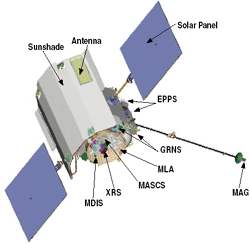
Today's launch of the MESSENGER spacecraft has been canceled due to weather constraints. The launch team will try again tomorrow, August 3, at 2:15:56 a.m. MESSENGER is a scientific investigation of the planet Mercury. Understanding Mercury, and the forces that have shaped it, is fundamental to understanding the terrestrial planets and their evolution. Just what is a terrestrial planet? It is a group of planets that are like Earth.


The MESSENGER spacecraft will orbit Mercury following three flybys of that planet. The orbital phase will use the flyby information as an initial guide to perform a focused scientific investigation of this mysterious world.

MESSENGER will enter Mercury orbit in March 2011 and carry out comprehensive measurements for one Earth year. The data-collection phase of the mission will conclude in March 2012.

Mission Overview
MESSENGER is a scientific investigation of the planet Mercury. Understanding Mercury, and the forces that have shaped it, is fundamental to understanding the terrestrial planets and their evolution.

MESSENGER is a MErcury Surface, Space ENvironment, GEochemistry, and Ranging mission to orbit Mercury following three flybys of that planet. The orbital phase will use the flyby data as an initial guide to perform a focused scientific investigation of this enigmatic world.

MESSENGER will investigate key scientific questions regarding Mercury’s characteristics and environment during these two complementary mission phases. Data are provided by an optimized set of miniaturized space instruments and the spacecraft telecommunications system.

MESSENGER will enter Mercury orbit in March 2011 and carry out comprehensive measurements for one Earth year. Orbital data collection concludes in March 2012.

Explore further: NOAA's latest mobile app provides free nautical charts for recreational boating

add to favorites email to friend print save as pdf

Related Stories

Cassini shapes first global topographic map of Titan

May 15, 2013

(Phys.org) —Scientists have created the first global topographic map of Saturn's moon Titan, giving researchers a valuable tool for learning more about one of the most Earth-like and interesting worlds ...

Spitzer telescope puts planets in a petri dish

May 06, 2013

(Phys.org) —Our galaxy is teeming with a wild variety of planets. In addition to our solar system's eight near-and-dear planets, there are more than 800 so-called exoplanets known to circle stars beyond ...

Eyeball earths

May 03, 2013

Alien worlds resembling giant eyeballs might exist around red dwarf stars, and researchers are now proposing experiments to simulate these distant planets and see how capable they are of supporting life.

Recommended for you

NASA's BARREL mission launches 20 balloons

1 hour ago

(Phys.org) —In Antarctica in January, 2013 – the summer at the South Pole – scientists released 20 balloons, each eight stories tall, into the air to help answer an enduring space weather question: ...

Power of US tornado dwarfs Hiroshima bomb

2 hours ago

Wind, humidity and rainfall combined precisely to create Monday's massive killer tornado in Oklahoma. The awesome amount of energy released dwarfed the power of the atomic bomb that leveled Hiroshima.

Climate change and wildfire: Synthesis of recent findings

5 hours ago

Concerns continue to grow about the effects of climate change on fire. Wildfires are expected to increase 50 percent across the United States under a changing climate, over 100 percent in areas of the West by 2050 as projected ...

Moore tornado a rarity, experts say

7 hours ago

Tornados, among the most violent of atmospheric storms, rarely reach the size and brutality of the twister that swept through an Oklahoma City suburb on Monday, experts say.

User comments : 0

More news stories

Power of US tornado dwarfs Hiroshima bomb

Wind, humidity and rainfall combined precisely to create Monday's massive killer tornado in Oklahoma. The awesome amount of energy released dwarfed the power of the atomic bomb that leveled Hiroshima.

NASA's BARREL mission launches 20 balloons

(Phys.org) —In Antarctica in January, 2013 – the summer at the South Pole – scientists released 20 balloons, each eight stories tall, into the air to help answer an enduring space weather question: ...

If you can remember it, you can remember it wrong

(Medical Xpress)—Native peoples in regions where cameras are uncommon sometimes react with caution when their picture is taken. The fear that something must have been stolen from them to create the photo ...