Spitzer Turns Two

Aug 26, 2005
Spitzer Turns Two

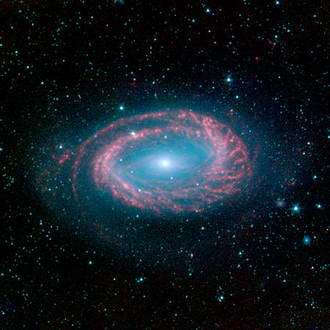
Two years ago today, NASA's Spitzer Space Telescope blasted into the same dark skies it now better understands. In just two years, the observatory's infrared eyes have uncovered a hidden universe teeming with warm stellar embryos, chaotic planet-forming disks and majestic galaxies, including the delightfully odd galaxy called NGC 4725 shown here.

This peculiar galaxy is thought to have only one spiral arm. Most spiral galaxies have two or more arms. Astronomers refer to NGC 4725 as a ringed barred spiral galaxy because a prominent ring of stars encircles a bar of stars at its center (the bar is seen here as a horizontal ridge with faint red features).

Our own Milky Way galaxy sports multiple arms and a proportionally smaller bar and ring.

In this false-color Spitzer picture, the galaxy's arm is highlighted in red, while its center and outlying halo are blue. Red represents warm dust clouds illuminated by newborn stars, while blue indicates older, cooler stellar populations. The red spokes seen projecting outward from the arm are clumps of stellar matter that may have been pushed together by instable magnetic fields.

NGC 4725 is located 41 million light-years away in the constellation Coma Berenices.

This picture is composed of four images taken by Spitzer's infrared array camera at 3.6 (blue), 4.5 (green), 5.8 (red), and 8.0 (red) microns. The contribution from starlight (measured at 3.6 microns) has been subtracted from the 5.8- and 8-micron images to enhance the visibility of the dust features.

Copyright 2005 by Space Daily, Distributed United Press International

Explore further: Galaxies fed by funnels of fuel

add to favorites email to friend print save as pdf

Related Stories

Galaxy's Ring of Fire

May 18, 2013

Johnny Cash may have preferred this galaxy's burning ring of fire to the one he sang about falling into in his popular song. The "starburst ring" seen at center in red and yellow hues is not the product of ...

Galaxies the way they were

Apr 03, 2013

(Phys.org) —Galaxies today come very roughly in two types: reddish, elliptically shaped collections of older stars, and bluer, spiral shaped objects dominated by young stars. The conventional wisdom is ...

Hubble observes the hidden depths of Messier 77

Mar 28, 2013

(Phys.org) —The NASA/ESA Hubble Space Telescope has captured this vivid image of spiral galaxy Messier 77, one of the most famous and well-studied galaxies in the sky. The patches of red across this image ...

Hunting high-mass stars with Herschel

Mar 27, 2013

(Phys.org) —In this new view of a vast star-forming cloud called W3, ESA's Herschel space observatory tells the story of how massive stars are born.

Recommended for you

Galaxies fed by funnels of fuel

23 hours ago

(Phys.org) —Computer simulations of galaxies growing over billions of years have revealed a likely scenario for how they feed: a cosmic version of swirly straws.

Dark, massive asteroid to fly by Earth on May 31

May 24, 2013

It's 1.7 miles long. Its surface is covered in a sticky black substance similar to the gunk at the bottom of a barbecue. If it impacted Earth it would probably result in global extinction. Good thing it is ...

Source of life running out: water scientists

May 24, 2013

The majority of people on Earth people will face severe water shortages within a generation or two if pollution and waste continues unabated, scientists warned at a conference in Bonn Friday.

Research team explains 'Lazarus' comets

May 24, 2013

Astronomers from the University of Antioquia have discovered a graveyard of comets. These once-dormant comets, dubbed by astronomers as "The Lazarus comets," are now rejuvenated.

User comments : 0

More news stories

Galaxies fed by funnels of fuel

(Phys.org) —Computer simulations of galaxies growing over billions of years have revealed a likely scenario for how they feed: a cosmic version of swirly straws.

Century-old science helps confirm global warming

(Phys.org) —Ocean measurements taken more than 135 years ago during the scientific expedition of HMS Challenger have provided further confirmation of human-produced global warming over the past century.