UA Physicists Find Key to Long-Lived Metal Nanowires
University of Arizona physicists have discovered what it takes to make metal 'nanowires' that last a long time. This is particularly important to the electronics industry, which hopes to use tiny wires -- that have diameters counted in tens of atoms -- in Lilputian electronic devices in the next 10 to 15 years.
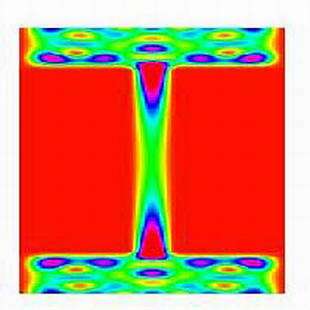
This illustration represents a metallic quantum wire before it's stretched to the breaking point. (Illustration: Courtesy of Charles Stafford)
Researchers predict that such nanotechnology will be the next Big Thing to revolutionize the computing, medical, power and other industries in coming decades.
Although researchers in Japan, the Netherlands, Spain, Brazil and the United States have had some success at making nanowires -- extremely small filaments that transport electrons -- the wires don't last long except at low temperatures.
What researchers need are robust nanowires that will take repeated use without failing at room temperature and higher.
UA post-doctoral associate Jerome Buerki and physics Professors Charles Stafford and Daniel Stein developed a theory that explains why nanowires thin away to nothing at non-zero temperatures. Energy fluctuations in a nanowire at higher temperatures create a collective motion, or "soliton," among atoms in the wire. As each of these kink-like structures propagates from one end of the wire to the other, the wire thins.
Stafford has posted movies that show this phenomenon on his Web page, www.physics.arizona.edu/~stafford/necking.htmlThe movie was made by the Takayanagi group at the Tokyo Institute of Technology.
"Our theory makes one very simple prediction, which is that the energy barrier that creates these kinks depends, very simply, on the square root of the surface tension of the wire," Stafford said. "That's quite counterintuitive, because naively you'd think that surface tension should actually make the filament unstable. But the larger the surface tension, the more stable the wire, regardless of the radius of the wire."
Creation of solitons, or kinks, in the wire depends on two competing forces - the surface tension and a quantum force that holds the wire together, Stafford explained. "It just so happens that the competition between those two forces leads to a kind of universal energy barrier which goes as the square root of the surface tension."
The discovery explains why experimentalists have had more luck at making longer-lived nanowires using such noble metals as gold and silver rather than sodium or other alkali metals. According to the UA physicists' theory, copper is the best metal for making nanowires because it has the largest natural surface tension of the nanowire metals.
"The hardest thing with developing nanowires, I think, is how to fabricate them in a controlled way," Stafford said. "The movies show how researchers can fabricate one tiny wire, but that's not connecting many such wires, or connecting them to make a circuit.
"But at least, our work says that these wires are very stable, and that we understand exactly how stable they are. I think that can give people confidence to move ahead with trying to do something practical with them."
The research, funded by the National Science Foundation, will be published this week in Physical Review Letters. The article, "Theory of Metastability in Simple Metal Nanowires,"appears online at link.aps.org/abstract/PRL/v95/390601 .
Source: University of Arizona


