Scientists One Step Closer to Forecasting 'Clear Skies' for Astronauts
Scientists funded by NASA have made big strides in learning how to forecast "all clear" periods, when severe space weather is unlikely. The forecasts are important because radiation from particles from the sun associated with large solar flares can be hazardous to unprotected astronauts, airplane occupants and satellites.
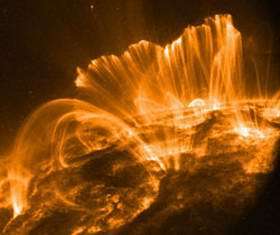
Image: Scientists study the complex patterns of solar magnetic field lines to predict storms, which is not always reliable. This new method combines computer models with images of the active solar surface and atmosphere (corona) from the TRACE (shown) and SOHO spacecraft. Credit: NASA/LMSAL.
"We have a much better insight into what causes the strongest, most dangerous solar flares, and how to develop forecasts that can predict an 'all clear' for significant space weather, for longer periods," said Dr. Karel Schrijver of the Lockheed Martin Advanced Technology Center (ATC), Palo Alto, Calif. He is lead author of a paper about the research published in the Astrophysical Journal.
Solar flares are violent explosions in the atmosphere of the sun caused by the sudden release of magnetic energy. Like a rubber band twisted too tightly, stressed magnetic fields in the sun’s atmosphere (corona) can suddenly snap to a new shape. They can release as much energy as one, 10 billion megaton nuclear bomb.
Predicting space weather is a complicated problem. Solar forecasters focus principally on the complexity of solar magnetic field patterns to predict solar storms. This method is not always reliable, because solar storms require additional ingredients to occur. It has long been known large electrical currents must be present to power flares.
Insight into the causes of the largest solar flares came in two steps. "First, we discovered characteristic patterns of magnetic field evolution associated with strong electrical currents in the solar atmosphere," said ATC's Dr. Marc DeRosa, co-author of the paper. "It is these strong electrical currents that drive solar flares."
Subsequently, the authors discovered the regions most likely to flare had new magnetic fields merge into them that were clearly out of alignment with the existing field. This emerging field from the solar interior appears to induce even more current as it interacts with the existing field.
The team also found flares do not necessarily occur immediately upon the emergence of a new magnetic field. Apparently the electrical currents must build up over several hours before the fireworks start. Predicting exactly when a flare will happen is like studying avalanches. They occur only after enough snow built up. Once the threshold is reached, the avalanche can happen anytime by processes not yet completely understood.
"We found the current-carrying regions flare two to three times more often than the regions without large currents," Schrijver said. "Also, the average flare magnitude is three times greater for the group of active regions with large current systems than for the other group."
The researchers made the discovery by comparing data about magnetic fields on the sun’s surface to the sharpest extreme-ultraviolet images of the solar corona. The magnetic maps were from the Michelson Doppler Imager (MDI) instrument on board Solar and Heliospheric Observatory (SOHO) spacecraft. SOHO is operated under a cooperative mission between the European Space Agency and NASA.
The corona images were from the NASA Transition Region and Coronal Explorer spacecraft (TRACE). The team also used computer models of a three-dimensional solar magnetic field without electrical currents based on SOHO images. Differences between images and models indicated the presence of large electrical currents.
"This is a result that is more than the sum of two individual missions," said Dr. Dick Fisher, Director of NASA's Sun-Solar System Connection Division. "It's not only interesting scientifically, but has broad implications for society."
Source: NASA


