Mirror Measures Vortex Drag
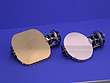
Airplanes generate trailing wake vortices which can be dangerous for following aircraft, especially on takeoff and landing. An onboard laser measuring device scans the air space in front of the plane, recognizes turbulence and will inform the pilot.
The volume of air traffic is constantly rising – many air routes are already overloaded. Frequent delays are encountered when machines are taking off and landing at major airports. The frequency of aircraft cannot be increased because they have to maintain a safety distance of up to six miles (11.1 kilometers). It is to ensure that the following airplane is not endangered by the vortex drag of the machine in front. This across-the-board safety distance is often more generous than required. If the position and the actual extent of the air vortex could be directly measured, the safety distance could be adjusted to the actual circumstances and shortened. Airports could then use their capacity to better effect.
“In the EU project I-Wake we are cooperating with eight teams from four different countries to develop a sensor which can determine whether the air is calm enough for a safe takeoff,” explains Thomas Peschel from the Fraunhofer Institute for Applied Optics and Precision Engineering IOF in Jena. “The optical scanner can recognize any turbulence and in future could deliver rapid and reliable measured results on board commercial aircraft. A prototype is currently being tested on a small Cessna plane.” The measurement principle is relatively simple:
A laser sends pulses into the air space in front of the aircraft. The light is scattered on aerosol or dust particles and registered by a detector. As a result of the Doppler effect, the wavelength of the incoming laser pulses is shifted according to whether the airborne particles are moving towards or away from the beam. From the difference relative to the incident wavelength, a software system calculates the strength of air turbulences within fractions of a second.
Core parts of the device are two precision mirrors, measuring 11 by 15 centimeters. One of the challenges which had to be overcome was to scan the air space at a relatively high frequency of around seven times per second. To keep forces of inertia and slight subsequent deformations as low as possible, the mirrors have to be lightweight but stiff. The aluminum plate they were manufactured from was perforated to minimize its mass. The perforations run parallel to the surface on the inside in order not to deteriorate mechanical and optical properties. At the same time, the reverse side of the mirrors were retained as a closed surface in order to provide even more rigidity.
Source: Fraunhofer-Gesellschaft
-
From lemons to lemonade: Reaction uses carbon dioxide to make carbon-based semiconductor,
32 comments
-
Thioridazine kills cancer stem cells in human while avoiding toxic side-effects of conventional cancer treatments,
3 comments
-
SpaceX private rocket blasts off for space station (Update),
42 comments
-
Climate scientists say they have solved riddle of rising sea,
31 comments
-
SpaceX capsule has 'new car' smell, astronauts say (Update),
4 comments
More news stories
Is a classical electrodynamics law incompatible with special relativity?
(Phys.org) -- The laws of classical electromagnetism that were developed in the 19th century are the same laws that scientists use today. They include Maxwell’s four equations along with the Lorentz la ...
Landmark calculation clears the way to answering how matter is formed
(Phys.org) -- An international collaboration of scientists, including Thomas Blum, associate professor of physics, is reporting in landmark detail the decay process of a subatomic particle called a kaon ...
May 25, 2012 |
4.3 / 5 (22) |
53
|
Lying in wait for WIMPs: Researchers seek to dramatically increase sensitivity of Large Underground Xenon detector
Although it's invisible, dark matter accounts for at least 80 percent of the matter in the universe. No one knows what it is, but most scientists would bet on weakly interacting massive particles, or WIMPs.
May 23, 2012 |
4 / 5 (7) |
18
|
Hawaii lab turns laser-powered bubbles into microrobots
(Phys.org) -- A team of scientists from the University of Hawaii are working on microrobots created from bubbles of air in a saline solution. The bubbles take on their title of robots as a laser ...
Sound increases the efficiency of boiling
Scientists at the Georgia Institute of Technology achieved a 17-percent increase in boiling efficiency by using an acoustic field to enhance heat transfer. The acoustic field does this by efficiently removing vapor bubbles ...
May 24, 2012 |
5 / 5 (2) |
2
'Unzipped' carbon nanotubes could help energize fuel cells, batteries
Multi-walled carbon nanotubes riddled with defects and impurities on the outside could replace some of the expensive platinum catalysts used in fuel cells and metal-air batteries, according to scientists at ...
Change in developmental timing was crucial in the evolutionary shift from dinosaurs to birds: study
At first glance, it's hard to see how a common house sparrow and a Tyrannosaurus Rex might have anything in common. After all, one is a bird that weighs less than an ounce, and the other is a dinosaur that ...
Computer model used to pinpoint prime materials for efficient carbon capture
When power plants begin capturing their carbon emissions to reduce greenhouse gases and to most in the electric power industry, it's a question of when, not if it will be an expensive undertaking.
T cells 'hunt' parasites like animal predators seek prey, study shows
By pairing an intimate knowledge of immune-system function with a deep understanding of statistical physics, a cross-disciplinary team at the University of Pennsylvania has arrived at a surprising finding: T cells use a movement ...
Stunning image of smallest possible five-ringed structure
Scientists have created and imaged the smallest possible five-ringed structure about 100,000 times thinner than a human hair and you'll probably recognise its shape.
Land and sea species differ in climate change response: study
(Phys.org) -- Marine and terrestrial species will likely differ in their responses to climate warming, new research by Simon Fraser University and Australia’s University of Tasmania has found.