Submerged volcanoes pose tsunami threat
Jul 28, 2005
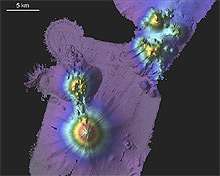
One of the submerged volcanoes found by the research teams

One of the world’s most active volcanic areas is a relatively unknown part of the seabed between New Zealand and Tonga, and could trigger a devastating tsunami at any moment, ANU geologist Professor Richard Arculus warned today.
While relatively little money is available for ocean research, submerged volcanoes pose a significant threat to communities across the Pacific, Professor Arculus said.

“Over the last six years, research teams from Australia, New Zealand, the USA, and Germany have mapped a relatively narrow strip of ocean stretching about 2000 kilometres from the north of New Zealand to Tonga, and found 75 previously unknown volcanoes. Only 10 volcanoes were known in the area prior to this research,” he said.

“If any one of these underwater volcanoes either explosively erupts or collapses in a sudden movement, it would have a massive impact on the ocean, triggering a tsunami which could devastate communities across the region. There is evidence from new high-resolution images of these volcanoes that these events have happened many times in the past.

“Australia has just one research ship equipped for seabed surveys, the RV Southern Surveyor and it is required to perform many different types of research each year. It is ironic that we know far more about the topography of Mars and the Moon than about Earth, simply because much of our planet is covered in water.”

Professor Arculus said significantly more research would be required to pinpoint volcanoes that pose a significant risk of triggering a tsunami. He is one of few Australian researchers currently engaged in researching submerged volcanoes.

To help expand the ranks of researchers skilled at studying the underwater environment, ANU is launching an elite new degree next year, the Bachelor of Global and Ocean Sciences, to train a new generation of ocean scientists.

“The sea is the last great unexplored frontier on Earth. This research is important not just because it could help forewarn us of cataclysmic eruptions and tsunamis, but also because submerged volcanoes offer a direct channel to the Earth’s mantle, releasing gases and elements trapped since the planet’s early days.

“These underwater vents support Earth’s earliest life forms, anaerobic bacteria which thrive in the chemicals and reduced gases released. They also are significant markers of rare mineral resources, such as gold, copper and zinc.

“The underwater terrain around some of these volcanoes is similar to the settings that existed around Broken Hill and other important mining areas – it’s just that the rocks are many million years younger with ongoing activity.”

Source: The Australian National University

Explore further: Bold action, big money needed to curb Asia floods

add to favorites email to friend print save as pdf

Related Stories

Carbonates make diamonds grow in the Earth's mantle

Apr 08, 2011

Diamonds that no-one ever sees can form deep in the Earth’s interior. This is due to the chemical conditions controlling the associated carbon cycle. Swiss researchers used laboratory experiments to show ...

Pioneering Deep-Sea Robot Lost at Sea

Mar 09, 2010

(PhysOrg.com) -- A pioneering deep-sea exploration robot -- one of the first successful submersible vehicles that was both unmanned and untethered to surface ships -- was lost at sea Friday, March 5, on a ...

Recommended for you

Bold action, big money needed to curb Asia floods

7 hours ago

Asia's flood-prone megacities should fund major drainage, water recycling and waste reduction projects to stem deluges and secure clean supply for their booming populations, experts said Sunday.

Heat-related deaths in Manhattan projected to rise

9 hours ago

Residents of Manhattan will not just sweat harder from rising temperatures in the future, says a new study; many may die. Researchers say deaths linked to warming climate may rise some 20 percent by the 2020s, ...

Dire outlook despite global warming 'pause': study

9 hours ago

A global warming "pause" over the past decade may invalidate the harshest climate change predictions for the next 50 to 100 years, a study said Sunday—though levels remain in the danger zone.

China 'will not accept' carbon tax on EU flights: report

12 hours ago

China will not pay for CO2 emissions by its airlines on flights within Europe, a top civil aviation official reportedly said after the European Commission warned eight Chinese firms face fines for nonpayment.

Mice, gerbils perish in Russia space flight

13 hours ago

A number of mice and eight gerbils sent into space in a Russian capsule destined to find out how well organisms can withstand extended flights perished during their journey, scientists said Sunday as the ...

User comments : 0

More news stories

Heat-related deaths in Manhattan projected to rise

Residents of Manhattan will not just sweat harder from rising temperatures in the future, says a new study; many may die. Researchers say deaths linked to warming climate may rise some 20 percent by the 2020s, ...

Mice, gerbils perish in Russia space flight

A number of mice and eight gerbils sent into space in a Russian capsule destined to find out how well organisms can withstand extended flights perished during their journey, scientists said Sunday as the ...

Kinks and curves at the nanoscale

One of the basic principles of nanotechnology is that when you make things extremely small—one nanometer is about five atoms wide, 100,000 times smaller than the diameter of a human hair—they are going ...

Honeybees trained in Croatia to find land mines

(AP)—Mirjana Filipovic is still haunted by the land mine blast that killed her boyfriend and blew off her left leg while on a fishing trip nearly a decade ago. It happened in a field that was supposedly ...