Physicists Entangle Photon and Atom in Atomic Cloud
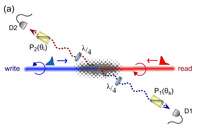
Quantum communication networks show great promise in becoming a highly secure communications system. By carrying information with photons or atoms, which are entangled so that the behavior of one affects the other, the network can easily detect any eavesdropper who tries to tap the system.
Physicists at the Georgia Institute of Technology have just reached an important
milestone in the development of these systems by entangling a photon and a single atom located in an atomic cloud. Researchers believe this is the first time an entanglement between a photon and a collective excitation of atoms has passed the rigorous test of quantum behavior known as a Bell inequality violation. The findings are a significant step in developing secure long-distance quantum communications. They appear in the July 22, 2005 edition of the Physical Review of Letters.
Relying on photons or atoms to carry information from one place to another, network security relies on a method known as quantum cryptographic key distribution. In this method, the two information-carrying particles, photonic qubits or atomic qubits, are entangled. Because of the entanglement and a rule in quantum physics that states that measuring a particle disturbs that particle, an eavesdropper would be easily detected because the very act of listening causes changes in the system.
But many challenges remain in developing these systems, one of which is how to get the particles to store information long enough and travel far enough to get to their intended destination. Photonic qubits are great carriers and can travel for long distances before being absorbed into the conduit, but they’re not so great at storing the information for a long time. Atomic qubits, on the other hand, can store information for much longer. So an entangled system of atoms and photons offers the best of both worlds. The trick is how to get them entangled in a simple way that requires the least amount of hardware.
Physicists Alex Kuzmich and Brian Kennedy think that taking a collective approach is the way to go. Instead of trying to isolate an atom to get it into the excited state necessary for it to become entangled with a photon, they decided to try to excite an atom in a cloud of atoms.
“Using a collective atomic qubit is much simpler than the single atom approach,” said Kuzmich, assistant professor of physics at Georgia Tech. “It requires less hardware because we don’t have to isolate an atom. In fact, we don’t even know, or need to know, which atom in the group is the qubit. We can show that the system is entangled because it violates Bell inequality.”
“With single atoms, its much more difficult to control the system because there is so much preparation that must be done,” said Kennedy, professor of physics at Georgia Tech. “For the collective excitation, the initial preparation of the atoms is minimal. You don’t have to play too much with their internal state – something that’s usually a huge concern.”
In addition to having the system pass the rigorous test of Bell inequality, researchers said they were able to increase the amount of time the atomic cloud can store information to several microseconds. That’s fifty times longer than it takes to prepare and measure the atom-photon entanglement.
Another challenge of quantum communication networks is that since photons can only travel so far before they get absorbed into the conduit, the network has to be built in nodes with a repeater at each connection.
“A very important step down the road would be to put systems like this together and confirm they are behaving in a quantum mechanical way,” said Kennedy.
Source: Georgia Institute of Technology


