Superconductivity in diamond
Apr 10, 2004
diamond

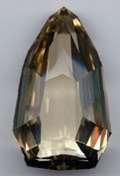
As well as holding pride of place as the most sought-after of all precious gemstones, diamond possesses a dazzling array of technologically useful properties. As well as being the hardest, most thermally conducting, and chemically resistant of all known materials it is also biocompatible, highly transparent and of great interest for use in the electronics industry. And now, to top it all off, Evgeni Ekimov and colleagues report in Nature, that under the correct conditions, it can also become a superconductor.

The diamonds they used were grown by the conventional industrial technique of subjecting graphite to high pressure and temperature, but to make it electrically conducting they added 2.8% of boron during growth, which contributes positive charge carriers (holes) to the material.

Authors report the discovery of superconductivity in boron-doped diamond synthesized at high pressure (nearly 100,000 atmospheres) and temperature (2,500–2,800 K). Electrical resistivity, magnetic susceptibility, specific heat and field-dependent resistance measurements show that boron-doped diamond is a bulk, type-II superconductor below the superconducting transition temperature Tc 4 K; superconductivity survives in a magnetic field up to Hc2(0) 3.5 T. The discovery of superconductivity in diamond-structured carbon suggests that Si and Ge, which also form in the diamond structure, may similarly exhibit superconductivity under the appropriate conditions.

Explore further: A quantum simulator for magnetic materials

add to favorites email to friend print save as pdf

Related Stories

Indecisive quanta

Feb 27, 2013

(Phys.org)—In ytterbium nickel phosphide there is a quantum critical point between the ferromagnetic and non-magnetic states that was previously not thought possible.

High-pressure science gets super-sized

Oct 24, 2012

(Phys.org)—The study of materials at extreme conditions took a giant leap forward with the discovery of a way to generate super high pressures without using shock waves whose accompanying heat turns solids to liquid.

Recommended for you

Spheres can form squares

2 hours ago

Everybody who has tried to stack oranges in a box knows that a regular packing of spheres in a flat layer naturally leads to a hexagonal pattern, where each sphere is surrounded by six neighbours in a honeycomb-like ...

A quantum simulator for magnetic materials

18 hours ago

Physicists understand perfectly well why a fridge magnet sticks to certain metallic surfaces. But there are more exotic forms of magnetism whose properties remain unclear, despite decades of intense research. ...

User comments : 0

More news stories

Spheres can form squares

Everybody who has tried to stack oranges in a box knows that a regular packing of spheres in a flat layer naturally leads to a hexagonal pattern, where each sphere is surrounded by six neighbours in a honeycomb-like ...

A quantum simulator for magnetic materials

Physicists understand perfectly well why a fridge magnet sticks to certain metallic surfaces. But there are more exotic forms of magnetism whose properties remain unclear, despite decades of intense research. ...

Engineers pioneer flat spray-on optical lens

A University of British Columbia engineer and a team of U.S. researchers have made a breakthrough utilizing spray-on technology that could revolutionize the way optical lenses are made and used.