Futuristic design wins competition for new Antarctic Research Station
Most challenging construction project on Earth
A futuristic design by Faber Maunsell and Hugh Broughton Architects has won the competition for the new British Antarctic Survey (BAS) Halley Research Station. In a very close-run contest, three finalists presented their ideas to a Jury Panel, technical advisory panel and BAS scientists.
Director of BAS, Professor Chris Rapley, CBE said, "This was an incredibly tough choice for the Jury Panel to make. We were presented with three outstanding schemes - each one of them creating an exceptional solution for living and working in this extreme environment. Of course, only one scheme can go through to construction. In my view each team is a winner and I really hope that the runners-up realise how much we value their ideas. This competition was launched to bring innovation and creativity to the challenge of building a scientific research station on a floating ice shelf. The process, which involved a working partnership between each design team and the BAS technical teams, was stimulating and exciting for everyone involved. I extend my warm congratulations to Faber Maunsell and Hugh Broughton Architects on their success at winning this competition."
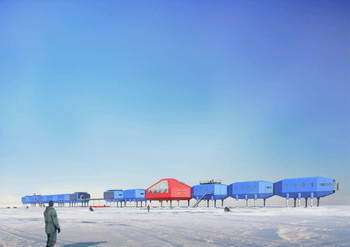
The new modular station, elevated on ski-based jackable legs to avoid burial by snow, can be towed across the ice. The modules are simple to construct and can be re-arranged or relocated inland periodically as the ice shelf flows towards the sea. A central module packed with stimulating areas for recreation and relaxation is flanked by a series of modules designed to suit the changing needs of the science programmes. It features renewable energy sources and new environmental strategies for fuel, waste and material handling.
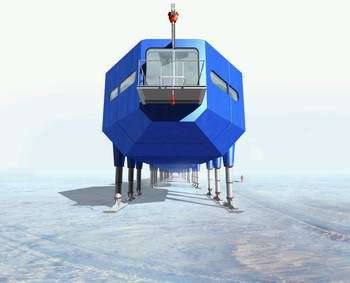
The new complex, replacing the current Halley V Research Station, is one of the most challenging construction projects on Earth. The present station is located 10,000 miles from the UK on the Brunt Ice Shelf, which is 150m thick and flows at a rate of 0.4 km per year northwest from Coats Land towards the sea where, at irregular intervals, it calves off as vast icebergs. Scientists predict a major calving event around 2010. There is a growing risk that ice on which the existing Halley Research Station sits could break off in the next decade. The new station will allow long-running research on global change to continue at the site where the ozone hole was discovered.
The competition, launched by BAS and RIBA in June 2004, attracted 86 Expressions of Interest. Six of those were selected to submit concept ideas and, in October 2004, three were commissioned by BAS to develop their concepts.
Source: British Antarctic Survey


