Safety light curtains with integral test mechanisms
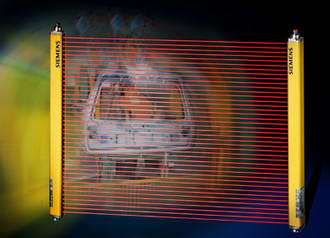
Siemens Automation and Drives (A&D) offers a new range of safety light curtains for protecting personnel and machinery. The Type 2 light curtains from the Simatic Sensors product range perform monitoring functions at resolutions of 20, 30, 40 and 90 millimeters. They cover protective field heights of 150 to 1800 millimeters, and have integral test mechanisms as well as startup/restart inhibit and contactor control.
This removes the need for the previously commonplace external test monitoring and evaluation devices, as well as the often extensive wiring overhead and additional control cabinet space they required. Typical areas of application of the new Type 2 light curtains include printing machinery, woodworking machinery, paper processing, textile and packaging machinery, as well as pick-and-place machines, and warehouse and conveyor systems.
The new products comply with the safety standards IEC/EN 954-1 (Category 2), IEC/EN 61496-1 (Type 2) and EN 61508 (SIL 2), as well as risk assessment in accordance with pr EN ISO 13489. The self-diagnostics system with 7-segment display simplifies startup and high-speed diagnostics on-site. The 7-segment display and several LEDs indicate the status of the safe outputs and any weak reception signal during operation. Patented encoding procedures for optical signal transmission guarantee noise-free operation for neighboring devices. The modern ASIC and signal processor technology is integrated into a rugged and rigid aluminum housing and can withstand the harsh conditions of day-to-day industrial use. The light curtains can be adjusted simply and quickly with self-arresting sliding blocks and swiveling brackets. Brackets with additional vibration damping are available as accessories.
-
From lemons to lemonade: Reaction uses carbon dioxide to make carbon-based semiconductor,
32 comments
-
Thioridazine kills cancer stem cells in human while avoiding toxic side-effects of conventional cancer treatments,
3 comments
-
SpaceX private rocket blasts off for space station (Update),
42 comments
-
Climate scientists say they have solved riddle of rising sea,
31 comments
-
SpaceX capsule has 'new car' smell, astronauts say (Update),
4 comments
More news stories
Nvidia trumpets Tegra 3 phone design wins for 2012
(Phys.org) -- Nvidias competitive war paint has a name, Tegra 3. On the heels of Nvidia announcements about lowering costs of its Tegra 3 processors and Nvidia-enabled tablets running Android Ice Cream ...
Dell tablet leak: 10.1-inch display, two-battery choice
(Phys.org) -- Headline after headline talks about vendors tablets in the wings as likely number-one contenders for the iPad. Such claims have justifiably been taken with a grain of salt, considering ...
Nvidia says Kai platform will turn price tide for tablets
(Phys.org) -- In March, Nvidia gave some signs that they were working to lower the cost of their Tegra 3 processors and they suggested consumers might see prices for Android tablets as low as $199. Connect ...
OmniVision tops up sensors for cameras, phones
(Phys.org) -- OmniVision has announced two high-resolution image sensors for the digital still and digital video camera market (DS/DVC) and higher end smartphones. In end-user language, it is a claim for superior ...
MIT researchers devise new means to synchronize a group of robots (w/ Video)
(Phys.org) -- For several years, roboticists have been working out ways to get a group of robots to perform synchronized activities as demonstrated most often in dance routines. Its not just about trying ...
'Unzipped' carbon nanotubes could help energize fuel cells, batteries
Multi-walled carbon nanotubes riddled with defects and impurities on the outside could replace some of the expensive platinum catalysts used in fuel cells and metal-air batteries, according to scientists at ...
Change in developmental timing was crucial in the evolutionary shift from dinosaurs to birds: study
At first glance, it's hard to see how a common house sparrow and a Tyrannosaurus Rex might have anything in common. After all, one is a bird that weighs less than an ounce, and the other is a dinosaur that ...
Computer model used to pinpoint prime materials for efficient carbon capture
When power plants begin capturing their carbon emissions to reduce greenhouse gases and to most in the electric power industry, it's a question of when, not if it will be an expensive undertaking.
T cells 'hunt' parasites like animal predators seek prey, study shows
By pairing an intimate knowledge of immune-system function with a deep understanding of statistical physics, a cross-disciplinary team at the University of Pennsylvania has arrived at a surprising finding: T cells use a movement ...
Stunning image of smallest possible five-ringed structure
Scientists have created and imaged the smallest possible five-ringed structure about 100,000 times thinner than a human hair and you'll probably recognise its shape.
Land and sea species differ in climate change response: study
(Phys.org) -- Marine and terrestrial species will likely differ in their responses to climate warming, new research by Simon Fraser University and Australia’s University of Tasmania has found.