First XMM-Newton images of impact
Jul 04, 2005
First XMM-Newton images of impact

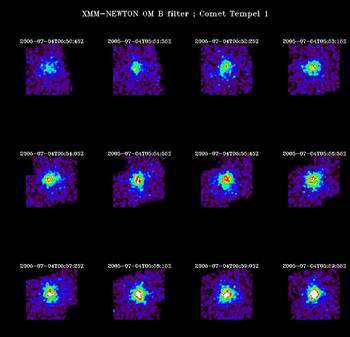
Images of Comet 9P/Tempel 1 taken by the Optical Monitor on ESA's XMM-Newton observatory, from two minutes before impact and until seven minutes after impact.
The first two images were taken just before impact, and in the following images the brightening due to impact is visible.

Hi-Res image available here.

These images were taken with the Optical Monitor blue filter, with which it is possible to measure the outcoming gas and dust. More images from the Optical Monitor are expected in the next hours.

Measurements with other XMM-Newton instruments should provide information about the chemical composition of the outcoming material.

XMM-Newton

Name The mission derives its name from its X-ray Multi-Mirror design. It also honours Sir Isaac Newton (1642-1727), the English physicist and mathematician. His demonstration that light can be split with a prism into its different colours forms the basis of the science that XMM-Newton is using.

Description XMM-Newton can detect more X-ray sources than any previous satellite. It is helping to solve many cosmic mysteries of the violent Universe, from what happens in and around black holes to the formation of galaxies in the early universe. It is built and designed to return data for a decade. XMM-Newton's high-tech design uses over 170 wafer-thin cylindrical mirrors spread over three telescopes. Its orbit takes it almost a third of the way to the Moon, so that astronomers can enjoy long, uninterrupted views of celestial objects.

Source: ESA

Explore further: Atlantic research expedition uncovers vast methane-based ecosystem

add to favorites email to friend print save as pdf

Related Stories

Recommended for you

Be prepared for weather extremes

1 hour ago

Unsettled weather is an Iowa mainstay, and so is Inside's annual reminder of the university's severe weather safety and preparedness guidelines—for storms, extreme heat, flooding and more.

US House sends message on Keystone pipeline

1 hour ago

US lawmakers agreed to a bill that would speed construction of a Canada-US oil pipeline and circumvent the need for President Barack Obama's approval for the $5 billion project.

Very Large Telescope celebrates 15 years of success

1 hour ago

(Phys.org) —With this new view of a spectacular stellar nursery ESO is celebrating 15 years of the Very Large Telescope—the world's most advanced optical instrument. This picture reveals thick clumps ...

New EU climate policy unlikely before 2015: Poland

2 hours ago

The European Union is unlikely to hammer out its new policy on global warming ahead of a global climate deal that could be clinched in 2015, Poland's environment minister said Wednesday.

User comments : 0

More news stories

Very Large Telescope celebrates 15 years of success

(Phys.org) —With this new view of a spectacular stellar nursery ESO is celebrating 15 years of the Very Large Telescope—the world's most advanced optical instrument. This picture reveals thick clumps ...

Be prepared for weather extremes

Unsettled weather is an Iowa mainstay, and so is Inside's annual reminder of the university's severe weather safety and preparedness guidelines—for storms, extreme heat, flooding and more.

Weird science: Crystals melt when they're cooled

(Phys.org) —Growing thin films out of nanoparticles in ordered, crystalline sheets, to make anything from microelectronic components to solar cells, would be a boon for materials researchers, but the physics ...

Unlocking secrets of cell reproduction

Research published in Open Biology today identifies, for the first time, nearly all the genes required for reproduction of a cell in a living organism.