Higher Precision Analysis Doesn’t Yield Pentaquark
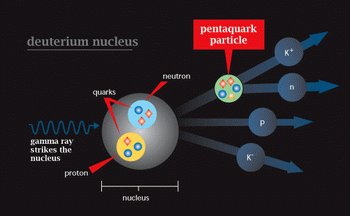
New, higher precision data that could only have been gathered at the Department of Energy’s Thomas Jefferson National Accelerator Facility (Jefferson Lab) shows the Theta-plus pentaquark doesn’t appear in another place it was expected.
Image: Researchers sent photons into deuterium nuclei to try to produce pentaquarks. If pentaquarks had been produced, sensitive detectors would have measured a particular mix of Kaons (K-mesons) and protons; neutrons could have been inferred from the data. The researchers did not detect this reaction. Image credit: JLab
This intriguing finding contradicts evidence previously presented by Jefferson Lab researchers that they had sighted a pentaquark, a particle built of five quarks. Volker Burkert, a Jefferson Lab Experimental Hall Leader, will present this preliminary result in a talk reviewing world pentaquark data at Lepton-Photon, the XXII International Symposium on Lepton-Photon Interactions at High Energy, in Uppsala, Sweden, on Friday, July 1.
The result comes from a very carefully crafted experiment that was designed to repeat Jefferson Lab’s original pentaquark search with a factor of ten higher statistics. Researchers in Jefferson Lab’s CEBAF Large Acceptance Spectrometer (CLAS) collaboration took data with a high-energy photon beam on a deuterium target March 13 – May 16, 2004. Deuterium is an isotope of hydrogen with one proton and one neutron in its nucleus. An earlier probe of this same region by CLAS revealed a possible signal for a pentaquark with mass 1542 MeV.
The new experiment searched for pentaquarks in this same channel at a level of precision at least 10 times higher, or one order of magnitude better, than the previous published result and found no pentaquarks. “The earlier results on the Theta-plus can not be reproduced in the analysis of the high-statistics run,” Burkert says.
Faced with this result, the collaboration re-analyzed the data from the original experiment, taking into account a new understanding of the background obtained from the recent run and improved statistical analysis software. The re-analysis revealed a much weaker signal for the pentaquark in the original experiment.
“One of the problems with the first pentaquark finding is that we didn’t completely understand the background,” Burkert says, “The statistical significance stated in the earlier result is likely due to a combination of statistical fluctuation with an underestimate of the background. We eliminated that problem with the second, higher-statistics run and a more rigorous analysis.”
The first pentaquark sighting was announced by SPring-8 researchers in the spring of 2003, and the same year, Jefferson Lab, ITEP and ELSA researchers announced that they, too, may have spotted tantalizing hints of the particle in data previously taken in other experiments. Several experiments since then have backed up these early sightings, while others have failed to confirm them. Jefferson Lab researchers are currently in the midst of several dedicated hunts for the pentaquark.
Most ordinary matter is built of quarks. They’re usually found in twos (as particles called mesons) and threes (as particles called baryons, such as protons and neutrons). While the pentaquark’s five-quark configuration is not forbidden by the theory of the strong interaction, finding one would be the first sighting of an exotic baryon.
Source: Thomas Jefferson National Accelerator Facility
