Probable observation of a supersolid helium phase
Just last year we have seen a Nobel Prize in physics awarded to Abrikosov, Ginzburg and Leggett for "pioneering contributions to the theory of superconductors and superfluids"
And now Nature publishes an article by E. Kim and M. Chan (vol 427, p. 225) who claim to observe a 'supersolid' He phase.
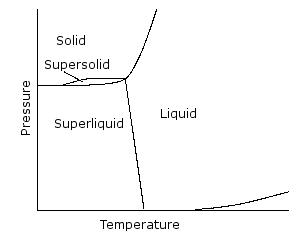
A supersolid is a spacially ordered superfluid. When quantum fluids, like 4He are cooled below a certain characteristic temperature, they undergo the superfluid transition and enter a state of 0 viscosity. It has been theorised that quantum fluids can undergo a similar transition from the solid phase.
Although it is intuitive to associate superflow only with the liquid phase, it has been proposed theoretically that superflow can also occur in the solid phase of He. Owing to quantum mechanical fluctuations, delocalized vacancies and defects are expected to be present in crystalline solid He, even in the limit of zero temperature. These zero-point vacancies can in principle allow the appearance of superfluidity in the solid. However, in spite of many attempts, such a ‘supersolid’ phase has yet to be observed
in bulk solid He.
Chan and graduate student Eun-Seong Kim made this discovery by using an apparatus that allowed them to compress helium-4 gas into a sponge-like glass disk with miniature atomic-scale pores while cooling it to almost absolute zero (below 2.176 K). The porous glass was inside a leak-tight capsule, and the helium gas became a solid when the pressure inside the capsule reached 40 times the normal atmospheric pressure. Chan and Kim continued to increase the pressure to 62 atmospheres. They also rotated the experimental capsule back and forth, monitoring the capsule's rate of oscillation while cooling it to the lowest temperature.
Something very unusual occurred when the temperature dropped to one-tenth of a degree above absolute zero. The oscillation rate suddenly became slightly more rapid, as if some of the helium had disappeared. However, Chan and Kim were able to confirm that the helium atoms had not leaked out of the experimental capsule because its rate of oscillation returned to normal after they warmed the capsule above one-tenth of a degree above absolute zero. So they concluded that the solid helium-4 probably had acquired the properties of a superfluid when the conditions were more extreme.
If the experiment is replicated, it would confirm that all three states of matter can enter into the “super” state, known as a Bose-Einstein condensation. The existence of a superfluid and a “supervapor” had previously been proven, but theorists had continued to debate about whether a supersolid was even possible.


