SMA Stares Into the Throat of a Cosmic Jet
Astronomers find jets everywhere when they look into space. Small jets spout from newborn stars, while huge jets blast out of the centers of galaxies. Yet despite their commonness, the processes that drive them remain shrouded in mystery. Even relatively nearby stellar jets hide their origins behind almost impenetrable clouds of dust. All stars, including our sun, pass through a jet phase during their "childhood," so astronomers are eager to understand how jets form and how they may influence star and planet formation.
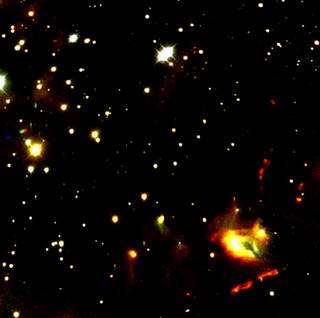
Image: Herbig-Haro 211 consists of two jets of material, visible at lower right, blasting from a young protostar hidden behind dust. The Submillimeter Array has looked deep within the inner regions of the jets, close to their launching point, in order to test predictions of jet formation models. This infrared image was taken using the FLAMINGOS camera, which was designed and constructed at the University of Florida. Credit: A.A. Muench-Nasrallah, CfA
At this week's meeting on submillimeter astronomy in Cambridge, Mass., astronomers described the latest results from an international collaboration using the Submillimeter Array (SMA) atop Mauna Kea, Hawaii. The SMA has begun to peer through the dust and home in on the sources of nearby stellar jets.
"Using the SMA, we can stare into the throat of the jet," said SMA project scientist Paul Ho of the Harvard-Smithsonian Center for Astrophysics (CfA). "We're getting close to seeing its launching point."
Astronomer Hsien Shang of the Academia Sinica Institute of Astronomy and Astrophysics (ASIAA) and her colleagues have created a model of jet formation that calculates temperatures, densities and brightnesses within stellar jets. SMA observations of a young star system prosaically named Herbig-Haro (HH) 211 have confirmed the validity of the model.
"Our model predicts what we will see about 100 astronomical units from the star," Shang said. (One astronomical unit is the average Earth-Sun distance of 93 million miles.) "With the SMA, we can begin to look at the HH 211 system at the scale of the model and test those predictions. So far, everything checks out."
HH 211 is located about 1,000 light-years away in the constellation Perseus. Astronomers estimate that the small protostar hidden within HH 211 is less than 1,000 years old-a mere baby by astronomical standards, so young that it is still growing by accumulating matter from a surrounding disk of gas and dust. The protostar eventually will become a low-mass star similar to the sun.
Although most of the matter in the disk will flow onto the star, some must be ejected outward to carry away excess angular momentum. Complex physical processes funnel that ejected matter into dual jets that shoot outward in opposite directions.
"Jets form very close to a protostar, within about 5 million miles of its surface according to the model we applied" said researcher Naomi Hirano (ASIAA). "The SMA can help test the jet model on the youngest protostars using molecular tracers from within that innermost region."
SMA's successor, the planned ALMA project, should finally reveal the nature of the engine powering these jets by peering into the core where they form.
"The SMA has brought us tantalizingly close to our goal-the answer to the question of how jets form," said Ho. "ALMA will take us those final few steps."
Headquartered in Cambridge, Mass., the Harvard-Smithsonian Center for Astrophysics (CfA) is a joint collaboration between the Smithsonian Astrophysical Observatory and the Harvard College Observatory. CfA scientists, organized into six research divisions, study the origin, evolution and ultimate fate of the universe.
Source: Harvard-Smithsonian Center for Astrophysics


