New 'biosensor' screens Air Force personnel and equipment for contamination - within minutes
Jun 16, 2005
New 'biosensor' screens Air Force personnel and equipment for contamination - within minutes

Air Force personnel will soon know within minutes if they or their equipment are contaminated with a biological agent, thanks to a new technology developed by the Air Force and a national laboratory.
Personnel will use the biosensor system to collect and isolate samples, detect and identify agents, and assess the seriousness of the threat.

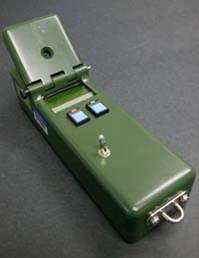
Image: The DNA Capture Element instrument was developed at the Pacific Northwest National Laboratory for the Air Force Research Laboratory. The "green box" is used to process samples of agents – in a matter of minutes – to determine if they are or aren't harmful.

"The system will provide an increased capability for Air Force Special Operations personnel to rapidly determine the presence of biological warfare agents in a combat environment," said Dr. Richard Stotts, counterproliferation branch chief within the Air Force Research Laboratory's Human Effectiveness Directorate. The device is compact, quickly identifies agents, can be used repeatedly and requires very little maintenance to keep it running in the field."

The system consists of a spray, developed at the directorate's Brooks City-Base, Texas, facilities, and a hand-held "green box," which determines if agents are present. The green box, or DNA Capture Element instrument, was developed by researchers at the Department of Energy's Pacific Northwest National Laboratory. The box uses an Air Force-developed biochemical assay based on aptamers, or single chain DNA fragments.

"We've used our lab's expertise to develop an instrument that's complementary to the Air Force's technology and that simultaneously satisfies the speed, specificity, sensitivity, portability, durability, health and safety needs," said Mike Lind, a senior advisor at PNNL. "The rapid detection capability of this instrument will be useful in a variety of applications, even outside of the armed forces."

With the prototype system, the user sprays the suspected contaminated area, creating a sample that can be picked up by a swab. The sample material on the swab is suspended in liquid by rinsing it in a container. Once in a liquid form, the sample is injected into a special flow cell, the place where the assay occurs.

The flow cell is currently designed for one-time use. Since the cell is sealed, it can be decontaminated by immersion in a bleach solution and then safely transported to a forensic laboratory for further analysis where it can be opened to retrieve the sample material.

A liquid crystal display, or LCD, provides a quantitative readout of the concentration of targeted material present, and a set of red, yellow, and green light emitting diodes provides an easily interpreted reading of the threat level. For instance, "no threat" is green, a barely detectable to medium level of an agent is one or two yellow dots, and a high detection level is red.

The biosensor system is designed to be reliable, disposable and cost-effective. The Air Force will continue testing the device over the next several months.

Source: PNNL

Explore further: The broken symphony of swinging metronomes

add to favorites email to friend print save as pdf

Related Stories

Climate and land use: Europe's floods raise questions

Jun 05, 2013

Less than three months after being battered by snow and ice, central Europe now finds itself fighting floods—and some scientists are pointing the finger at human interference with the climate system.

Green conversion of heat to electricity

May 21, 2013

Soon, it will be possible to produce electricity from heat over 30 degrees emitted from a waste incinerator, refinery, or data processor. The start-up Osmoblue has just confirmed the feasibility of this new ...

Olive oil assays may help assure authenticity

May 10, 2013

Though the price makes you wince, you might just buy that bottle of your favorite olive oil anyway. Perhaps it's exactly what you want for the salad dressing you're making tonight and for your special stir-fry ...

Recommended for you

Sony chief says time needed to study proposal

13 minutes ago

Sony Corp. needs more time to study a key proposal from a U.S. hedge fund to spin off a part of its entertainment unit as a way to propel its fledgling revival, the chief executive told shareholders Thursday.

Kim Dotcom slams Megaupload 'data massacre'

9 hours ago

Megaupload founder Kim Dotcom Thursday condemned a Dutch company's decision to delete million of files belonging to users of his defunct website, calling it "the largest data massacre in the history of the ...

US seizure of journalist records called 'chilling'

9 hours ago

The US government's secret seizure of Associated Press phone records had a "chilling effect" on newsgathering by the agency and other news organizations, AP's top executive said Wednesday.

Microsoft mulled buying Nokia unit

9 hours ago

Microsoft was in talks to boost its position in the mobile phone market by buying the devices business from Nokia but failed to seal a deal, the Wall Street Journal reported Wednesday.

User comments : 0

More news stories

Multiview 3-D photography made simple

Computational photography is the use of clever light-gathering tricks and sophisticated algorithms to extract more information from the visual environment than traditional cameras can.

Tech companies eye security that goes beyond passwords

In late February, a thief or thieves cracked into Evernote's digital vault filled with log-ins, passwords and email addresses belonging to 50 million users. It was a shocking cyberattack considering the Redwood City, Calif., ...

Danish chemists in molecular chip breakthrough

Electronic components built from single molecules using chemical synthesis could pave the way for smaller, faster and more green and sustainable electronic devices. Now for the first time, a transistor made ...

China astronauts float water blob in kids' lecture

Astronauts struck floating martial arts poses, twirled gyroscopes and manipulated wobbling globes of water during a lecture Thursday from China's orbiting space station that's part of efforts to popularize ...