How Your Garden Grows
May 25, 2005
How Your Garden Grows

Stumped scientists figure out plant growth mechanism

Just how does your garden grow? Plant scientists have long pondered the same question. For decades, the plant science community has known that auxins--a class of plant growth hormones--control many aspects of plant growth and development, including cell enlargement, formation of buds, roots, flowers, and fruit, and autumnal loss of leaves.

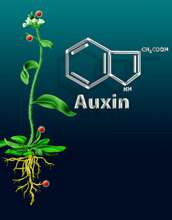
Image: Plant growth hormones, known as auxins, influence a variety of plant processes and are produced in growth regions throughout the plant (red dots). Researchers have worked out the series of molecular events the hormone uses to make plants grow. Credit: Nicolle Rager Fuller, NSF

Exactly how auxins do all that has been a thorny uncertainty, but now the molecular steps in the growth process have been worked out.

In the May 26 issue of the journal Nature, Mark Estelle and colleagues at Indiana University, Bloomington, show that to do its job, auxin must first bind with a protein called TIR1. When it's time to grow, the auxin-TIR1 complex signals for the destruction of another protein that puts the brakes on plant growth. With the brakes off, growth genes become active, and the plant gets a boost.

"This long-sought after discovery represents an important advance in our understanding of fundamental biological processes," says Jane Silverthorne, program director at the National Science Foundation, which supported this research. "This advance in basic plant biology could also have important applications to developing improved crops."

Auxins and synthetic replicas are widely used commercially to produce more vigorous growth, promote root formation in plants not easily propagated by stem cuttings, control flowering and fruiting, retard fruit drop, and to produce seedless varieties of some fruit like tomatoes. As auxins are found in all members of the plant kingdom, this breakthrough will not only allow researchers to better understand plant growth and development signals, it may also lead to improved cultivation practices.

The research was also supported by the National Institutes of Health and the U.S. Department of Energy.

Source: NSF

Explore further: Weekends are the best time to buy airline tickets, researchers find

add to favorites email to friend print save as pdf

Related Stories

When a gene is worth 2

Mar 22, 2013

The notion that each gene can only codify for a single protein has been challenged for some years. Yet, the functional outcomes that may result from genes encoding more than one protein are still largely unknown.

Herbicide may affect plants thought to be resistant

Nov 22, 2011

Purdue University researchers have discovered a fine-tuning mechanism involved in plant root growth that has them questioning whether a popular herbicide may have unintended consequences, causing some plants to need more ...

Getting to the root of nutrient sensing

Jun 14, 2010

New research published by Cell Press in the June 15th issue of the journal Developmental Cell, reveals how plants modify their root architecture based on nutrient availability in the soil.

Recommended for you

The ascent of man: Why our early ancestors took to two feet

14 hours ago

A new study by archaeologists at the University of York challenges evolutionary theories behind the development of our earliest ancestors from tree dwelling quadrupeds to upright bipeds capable of walking and scrambling.

Challenging the public's view of gender and science

15 hours ago

According to She Figures 2012, which analyses gender equality in research, in 2010 women accounted for only 10 % of university rectors in Europe and 15.5 % were heads of institutions of the higher education ...

User comments : 0

More news stories

Challenging the public's view of gender and science

According to She Figures 2012, which analyses gender equality in research, in 2010 women accounted for only 10 % of university rectors in Europe and 15.5 % were heads of institutions of the higher education ...

Galaxies fed by funnels of fuel

(Phys.org) —Computer simulations of galaxies growing over billions of years have revealed a likely scenario for how they feed: a cosmic version of swirly straws.

Google eyes emerging markets networks

Google has become deeply involved in a series of projects to build and operate wireless networks in emerging markets including sub-Saharan Africa and Southeast Asia, a report said Friday.