AWACSS Hunts Hormones and Pesticides in Drinking Water
May 12, 2005
new portable analysis system for detecting harmful substances in bodies of water

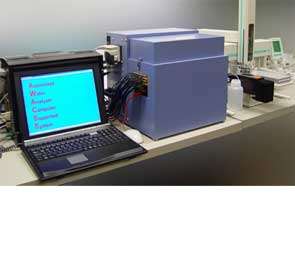
Siemens has developed a new portable analysis system for detecting harmful substances in bodies of water. As reported in the latest issue of the company’s research magazine "Pictures of the Future", the suitcase-sized device can test samples on its own and send the results to a central server. Previously, the samples had to be collected by hand and subsequently analyzed in the laboratory. Part of an EU project, the system was developed by researchers from Corporate Technology in Erlangen, in collaboration with the University of Tübingen, the Water Technology Center in Karlsruhe and other partners. A model was recently displayed at the IFAT Environment and Waste Disposal trade fair in Munich.

The drinking water drawn from lakes, rivers and ground water wells is subject to regular quality checks in Germany. In addition, the testing of surface water is prescribed by the European Union. It often takes one to two days until the results of testing are available. With the AWACSS system (Automated Water Analyzer Computer Supported System), though, no more than 15 minutes is needed to check for 32 different substances, ranging from antibiotics and pesticides to hormones. The device can detect even tiny concentrations of less than one microgram (one millionth of a gram) per liter. This level of precision is sufficient to determine if the water contains any pesticides. The results of the test are saved by a local computer, from which the data is transmitted via a wireless modem or a local area network (LAN) to a central server, where the data is then compared with existing parameters. If any discrepancies are discovered, the operator is notified by e-mail or text message.

The key component of AWACSS is a biochip that captures molecules of environmental toxins. The water sample is first mixed with antibodies that are marked with a fluorescent pigment. If the sample contains molecules of herbicides, for example, the antibodies attach themselves to the toxic particles. Once this process is completed, a pump propels the liquid across a small glass biochip coated with a layer of captor molecules. These molecules capture the antibodies, along with the toxins, while the remaining particles are rinsed from the chip. Laser light is used to cause the captured antibodies to glow, making them detectable by the device’s optical sensor. A single chip can be used for about 300 tests.

Explore further: Daylight Saving Time spurs drop in crime rate

add to favorites email to friend print save as pdf

Related Stories

Watching molecules grow into microtubes

Feb 22, 2013

Sometimes the best discoveries come by accident. A team of researchers at Washington University in St. Louis, headed by Srikanth Singamaneni, PhD, assistant professor of mechanical engineering & materials science, unexpectedly ...

Video-article shows how to purify magnetic bacteria

Nov 15, 2012

Magnetotactic bacteria, like Magnetospirillum magneticum, have evolved cellular processes that allow them to take up iron molecules to produce magnetic nanocrystals like magnetite. Since they were first ...

Making sense of misfolded proteins

Oct 03, 2012

The endoplasmic reticulum of cells provides a pivotal quality-control system that eliminates improperly folded, or misfolded, glycoproteins, such as antibodies and hormones. The UDP-glucose:glycoprotein glycotransferase ...

Keeping time: Circadian clocks

Oct 02, 2012

Our planet was revolving on its axis, turning night into day every 24 hours, for 4.5 billion years - long before any form of life existed here. About a billion years later, the very first simple bacterial ...

Recommended for you

Daylight Saving Time spurs drop in crime rate

3 minutes ago

(Phys.org) —Researchers are no longer in the dark about when criminals are most likely to attack. William & Mary economist Nicholas Sanders teamed up with the University of Virginia's Jennifer Doleac to study the connection ...

US scientist not involved in classified research: witnesses

May 17, 2013

Colleagues of a US scientist found hanged in Singapore last year told a coroner's inquiry Friday he was not involved in projects with military applications and was never asked to compromise any country's national security.

User comments : 0

More news stories

Engineers' nanoantennas improve infrared sensing

(Phys.org) —A team of University of Pennsylvania engineers has used a pattern of nanoantennas to develop a new way of turning infrared light into mechanical action, opening the door to more sensitive infrared ...

Mapping a route to stem cell therapies

Monash University researchers are shedding light on the complex processes that underpin the creation and differentiation of stem cells, bringing closer the promise of 'miracle' therapies.

Lymphatic fluid takes detour

When tumours metastasise, they can block lymphatic vessels, as researchers from ETH Zurich have discovered using a new method. The lymphatic fluid subsequently has to find a new path through the tissue. Such ...