Research Shows Overfishing Of Sharks Key Factor In Coral Reef Decline
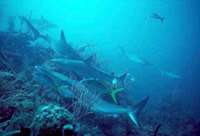
Unprecedented study describes sources contributing to decline of Caribbean reefs
Their position at the pinnacle of the marine food chain is legendary.
Now, understanding sharks and their significance as top predators - and the consequences of human activity towards them - has taken on new importance through a new study by scientists in San Diego and Spain.
Jordi Bascompte and Carlos Melián of the Integrative Ecology Group, Estación Biológica de Doñana, Consejo Superior de Investigaciones Científicas, in Sevilla, Spain, and Enric Sala of Scripps Institution of Oceanography at the University of California, San Diego, developed an unprecedented model of a Caribbean marine ecosystem and details of its intricate predator-prey interactions. This food “web” covered 1,000 square kilometers to a depth of 100 meters and included some 250 species of marine organisms. The study, published in the April 12 edition of the Proceedings of the National Academy of Sciences, included an intricate network of more than 3,000 links between these species.
The project was one of the largest and most detailed investigations of marine food webs and the first study to integrate food web structure, dynamics and conservation.
One of the most striking products of the study is a stark picture of human impacts on marine ecosystems and the consequences of targeted fishing. In the Caribbean, overfishing of sharks triggers a domino effect of changes in abundance that carries down to several fish species and contributes to the overall degradation of the reef ecosystem. Overfishing species randomly, the study shows, is not likely to cause these cascading effects.
“It appears that ecosystems such as Caribbean coral reefs need sharks to ensure the stability of the entire system,” said Sala, deputy director of the Center for Marine Biodiversity and Conservation at Scripps.
When sharks are overfished, a cascade of effects can lead to a depletion of important grazers of plant life. This is because there are fewer sharks to feed on carnivorous fish such as grouper—causing an increase in their numbers and their ability to prey on parrotfishes. The removal of plant-eating animals such as parrotfishes has been partly responsible for the shift of Caribbean reefs from coral to algae dominated, the authors note. Thus overfishing of sharks may contribute further to the loss of resistance of coral reefs to multiple human disturbances.
“The community-wide impacts of fishing are stronger than expected because fishing preferentially targets species whose removal can destabilize the food web,” the authors conclude in their report.
Because of their comprehensive approach in developing the intricate food web, the authors say their study and its results address more than individual species protection and speak to larger ecosystem protection issues.
“The paper presents a community-wide approximation of conservation problems,” said Bascompte. “We cannot asses all of the implications of overfishing by only looking at the target species or a few others. Species are embedded in a complex network of relationships and this network has a particular shape. This has large implications for the propagation of the consequences of overfishing through the whole food web.”
Funding for the study was provided by the Spanish Ministry of Science and Technology and a grant from the History of Marine Animal Populations Program of the Census of Marine Life, which was sponsored by the Alfred P. Sloan Foundation.
Source: University of California, San Diego


