Astronomers Expect To Be "Dazled" By Views Of Ancient Universe
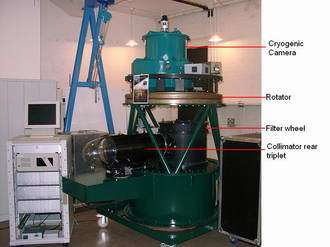
For the last five years, a team of astronomers at the University of Cambridge and the Anglo-Australian Observatory in Sydney, Australia, has been building a special instrument to search for the most distant galaxies in the Universe.
Known as DAZLE (Dark Age Redshift Lyman Explorer), the 21st century "time machine" will be able to look back 12,800 million years to the end of the Dark Ages, when the very first stars were appearing from the gloom that dominated the Universe shortly after the Big Bang.
Image: Picture of DAZLE in Cambridge laboratory
On Wednesday 6 April, Dr. Richard McMahon (Institute of Astronomy, University of Cambridge) will be describing to the RAS National Astronomy Meeting in Birmingham the scientific contribution that DAZLE will make. On Thursday, Dr. Ian Parry will speak about the technical challenges of building such a pioneering instrument.
“DAZLE is a special, highly sensitive, imaging instrument that detects infrared light,” said McMahon. “It has been designed to search for galaxies that emit no radiation at optical wavelengths but emit light at infra-red wavelengths that are invisible to the human eye.”
DAZLE is optimised to detect faint emission lines in the spectra of distant galaxies. These lines are very hard to detect because of the intense infrared emission created high in the Earth’s atmosphere. DAZLE uses specially designed filters that block out 99.99% of the glow from the Earth’s atmosphere. Astronomers intend to use DAZLE to detect the most distant galaxies known to humankind by searching for redshifted light emissions from hydrogen gas that has been heated by very hot young stars.
The first observing run with DAZLE is planned to take place later this year on the European Southern Observatory’s 8-metre Very Large Telescope, located in Chile. In this first search, DAZLE will search a narrow window in the sky at an infrared wavelength that corresponds to a redshift of 7.8, equivalent to 12.8 billion light years. This means that the light left these distant galaxies when the Universe was 12.8 billion years younger than it is today - when the Universe was 500 times smaller in volume.
After the search at a redshift of 7.8 is successful, the team then plan to use DAZLE to search for galaxies in another window in the sky emission at a redshift of 8.8, equivalent to a distance of 12.9 billion light years.
“Previous attempts to look back this far in time have so far been unsuccessful, so this could be a groundbreaking observation,” said McMahon.
“At this early time in the history of the Universe, a major change occurred in the gas in the Universe,” he added.
“After the Big Bang, the Universe expanded and cooled down to a temperature of -270C, close to absolute zero. However, since humans exist we know that the Universe must have been heated up again. We shall use DAZLE to try to determine exactly when the Universe was heated up for the second time, during the birth of the first stars.”
"Astronomers believe that this reheating was carried out by ultraviolet light from young hot stars in small galaxies,” explained Dr. Anthony Horton (University of Cambridge). “Stars in these baby galaxies formed some of the chemical elements - such as carbon, nitrogen, and iron - that are in our bodies.”
“DAZLE will be able to detect small, infant galaxies which are giving birth to stars – perhaps one hundredth the size of the Milky Way. DAZLE can detect galaxies which are forming stars at a rate where they are converting a mass of hydrogen and helium equal to the Sun into new stars each year,” said Dr. Ian Parry, another of the Cambridge team.
Source: Royal Astronomical Society (RAS)


