Swift Mission Nabs Its First Distance Measurement to Star Explosion
Apr 05, 2005
Swift

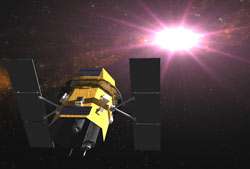
The NASA-led Swift mission has measured the distance to two gamma-ray bursts -- back to back, from opposite parts of the sky -- and both were from over nine billion light years away, unleashed billions of years before the Sun and Earth formed.
These represent the mission's first direct distance, or redshift, measurements, its latest milestone since being launched in November 2004. The distances were attained with Swift's Ultraviolet/OpticalTelescope (UVOT).
The Swift science team said that these types of distance measurements will become routine, allowing scientists to create a map to understand where, when and how these brilliant, fleeting bursts of light are created.

"Swift will detect more gamma-ray bursts than any satellite that has come before it, and now will be able to pin down distances to many of these bursts too," said Dr. Peter Roming, UVOT Lead Scientist at Penn State. "These two aren't distance record-breakers, but they're certainly from far out there. The second of the two bursts was bright enough to be seen from Earth with a good backyard telescope."

Gamma-ray bursts are the most powerful explosions known in the Universe and are thought to signal the birth of a black hole --either through a massive star explosion or through a merger smaller black holes or neutron stars. Several appear each day from our vantage point. They are difficult to detect and study, however, because they occur randomly from any point in the sky and last only a few milliseconds to about a minute.

Swift, with three telescopes, is designed to detect bursts and turn autonomously within seconds to focus its telescopes on the burst afterglow, which can linger for hours to weeks. The UVOT is a joint product of Penn State and the Mullard Space Science Laboratory in England.

Swift detected bursts on March 18 and 19, as indicted in their names: GRB 050318 and GRB 050319. The UVOT team estimated that the redshifts are 1.44 and 3.24, respectively, which corresponds to distances of about 9.2 billion and 11.6 billion light years. (The second estimate reflects a more precise measurement made with the ground-based Nordic Optical Telescope.) Distance measurements are attained through analysis of the burst afterglow.

Swift has detected 24 bursts so far. GRB 050318 was the first burst in which the UVOT detected an afterglow. The lack of afterglow detection is interesting in its own right, Roming said, because it helps scientists understand why some bursts create certain kinds of afterglows, if any. For example, Swift's X-ray Telescope has detected afterglows from several bursts. The UVOT detected afterglows in GRB 050318 and GRB 050319 in optical light, but not significantly in ultraviolet.

"Every burst is a little different, and when we add them all up we will begin to see the full picture," said Dr. Keith Mason, the U.K. UVOT Lead at University College London's Mullard Space Science Laboratory.

Mason said that UVOT distance measurements will become more precise in the upcoming months as new instruments aboard Swift are employed.

Swift is a medium-class explorer mission managed by NASA Goddard Space Flight Center in Greenbelt, Md. Swift is a NASA mission with participation of the Italian Space Agency and the Particle Physics and Astronomy Research Council in the United Kingdom. It was built in collaboration with national laboratories, universities and international partners, including Penn State; Los Alamos National Laboratory in New Mexico; Sonoma State University in California; the University of Leicester in Leicester, England; the Mullard Space Science Laboratory in Dorking, England; the Brera Observatory of the University of Milan in Italy; and the ASI Science Data Center in Rome, Italy.

More information about each of the Swift-detected gamma-ray bursts, updated every five minutes, is available on the web at: grb.sonoma.edu

Source: Penn State

Explore further: Bold action, big money needed to curb Asia floods

add to favorites email to friend print save as pdf

Related Stories

Swift satellite monitors departing Comet Garradd

Apr 13, 2012

(Phys.org) -- An outbound comet that provided a nice show for skywatchers late last year is the target of an ongoing investigation by NASA's Swift satellite. Formally designated C/2009 P1 (Garradd), the unusually ...

Swift narrows down origin of important supernova class

Mar 20, 2012

(PhysOrg.com) -- Studies using X-ray and ultraviolet observations from NASA's Swift satellite provide new insights into the elusive origins of an important class of exploding star called Type Ia supernovae. ...

Swift Satellite records early phase of gamma ray burst

Mar 02, 2009

(PhysOrg.com) -- UK astronomers, using a telescope aboard the NASA Swift Satellite, have captured information from the early stages of a gamma ray burst - the most violent and luminous explosions occurring ...

NASA's Swift looks to comets for a cool view

Dec 03, 2008

NASA's Swift Gamma-ray Explorer satellite rocketed into space in 2004 on a mission to study some of the highest-energy events in the universe. The spacecraft has detected more than 380 gamma-ray bursts, fleeting ...

Swift Observes An Unusual Bang In The Far Universe

Apr 06, 2006

Almost 40 years have passed since top secret nuclear weapon warning satellites accidentally discovered bursts of high energy gamma rays coming from space. Although many thousands of gamma ray bursts (GRBs) have since been ...

Swift Sees Pinwheel Galaxy, Satellite Fully Operational

Feb 01, 2005

The Swift satellite's Ultraviolet/Optical Telescope (UVOT) has seen first light, capturing an image of the Pinwheel Galaxy, long loved by amateur astronomers as the "perfect" face-on spiral galaxy. The UVO ...

Recommended for you

Bold action, big money needed to curb Asia floods

11 hours ago

Asia's flood-prone megacities should fund major drainage, water recycling and waste reduction projects to stem deluges and secure clean supply for their booming populations, experts said Sunday.

Heat-related deaths in Manhattan projected to rise

13 hours ago

Residents of Manhattan will not just sweat harder from rising temperatures in the future, says a new study; many may die. Researchers say deaths linked to warming climate may rise some 20 percent by the 2020s, ...

Dire outlook despite global warming 'pause': study

13 hours ago

A global warming "pause" over the past decade may invalidate the harshest climate change predictions for the next 50 to 100 years, a study said Sunday—though levels remain in the danger zone.

China 'will not accept' carbon tax on EU flights: report

16 hours ago

China will not pay for CO2 emissions by its airlines on flights within Europe, a top civil aviation official reportedly said after the European Commission warned eight Chinese firms face fines for nonpayment.

Mice, gerbils perish in Russia space flight

17 hours ago

A number of mice and eight gerbils sent into space in a Russian capsule destined to find out how well organisms can withstand extended flights perished during their journey, scientists said Sunday as the ...

User comments : 0

More news stories

Heat-related deaths in Manhattan projected to rise

Residents of Manhattan will not just sweat harder from rising temperatures in the future, says a new study; many may die. Researchers say deaths linked to warming climate may rise some 20 percent by the 2020s, ...

Mice, gerbils perish in Russia space flight

A number of mice and eight gerbils sent into space in a Russian capsule destined to find out how well organisms can withstand extended flights perished during their journey, scientists said Sunday as the ...

Honeybees trained in Croatia to find land mines

(AP)—Mirjana Filipovic is still haunted by the land mine blast that killed her boyfriend and blew off her left leg while on a fishing trip nearly a decade ago. It happened in a field that was supposedly ...

Kinks and curves at the nanoscale

One of the basic principles of nanotechnology is that when you make things extremely small—one nanometer is about five atoms wide, 100,000 times smaller than the diameter of a human hair—they are going ...