New Technique Enables Scientists to Track Molecular Energy Transfer in Photosynthesis
Scientists have been able to follow the flow of excitation energy in both time and space in a molecular complex using a new technique called two-dimensional electronic spectroscopy. While holding great promise for a broad range of applications, this technique has already been used to make a surprise finding about the process of photosynthesis. The technique was developed by a team of researchers with the U.S. Department of Energy’s Lawrence Berkeley National Laboratory and the University of California at Berkeley.
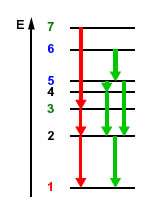
Image: In their latest photosynthesis studies, Berkeley scientists found two main energy transfer pathways in which some molecules were by-passed in the process. In one pathway, where there were seven potential energy transfer steps, the process was completed in three steps. In the other, where there were six potential transfer steps, the process was completed in either three or two steps.
“I think this will prove to be a revolutionary method for studying energy flow in complex systems where multiple molecules interact strongly,” said Graham Fleming, Deputy Director of Berkeley Lab, and an internationally acclaimed leader in spectroscopic studies of the photosynthetic process. “Using two-dimensional electronic spectroscopy, we can map the flow of excitation energy through space with nanometer spatial resolution and femtosecond temporal resolution.”
Fleming, also a professor of chemistry with UC Berkeley, is the principal investigator of this research, and co-author of a paper which appears in the March 31, 2005 issue of the journal Nature, entitled “Two-Dimensional Spectroscopy of Electronic Couplings in Photosynthesis.” Co-authoring the paper with Fleming were Tobias Brixner, Jens Stenger, Harsha Vaswani, Minhaeng Cho and Robert Blankenship.
Two-dimensional electronic spectroscopy involves sequentially flashing a sample with light from three laser beams, delivered in pulses only 50 femtoseconds (50 millionths of a billionth of a second) in length, while a a fourth beam is used as a local oscillator to amplify and phase-match the resulting spectroscopic signals. Fleming likens the technique to that of the early super-heterodyne radios, in which an incoming high frequency radio signal was converted by an oscillator to a lower frequency for more controllable amplification and better reception. In the case of 2-D electronic spectroscopy, scientists can track the transfer of energy between molecules that are coupled (connected) through their electronic and vibrational states in any photoactive system, macromolecular assembly or nanostructure.
“This technique should also be useful in studies aimed at improving the efficiency of molecular solar cells,” Fleming said. In the Nature paper, he and his colleagues describe how they successfully used 2-D electronic spectroscopy to record the first direct measurement of electronic couplings in the Fenna-Matthews-Olson (FMO) photosynthetic light-harvesting protein, a molecular complex in green sulphur bacteria that absorbs photons and directs the excitation energy to a reaction center where it can be converted to chemical energy.
“FMO is a model system for studying energy transfer in the photosynthetic process because it is relatively simple (consisting of only seven pigment molecules) and its chemistry has been well characterized,” Fleming said.
“As in all photosynthetic systems, the conversion of light into chemical energy is driven by electronic couplings between molecules and we monitored the process as a function of time and frequency.”
Fleming and his colleagues expected to find that the excitation energy from harvested photons in the light-capturing pigment molecules was transported to the FMO reaction center molecules step-by-step down the energy ladder. Instead, they discovered distinct energy pathways, based on the spatial arrangements of the molecules, whereby some of the intermediate steps in the energy ladder are skipped.
“Excitation energy moved through the FMO complex in a smaller number of steps but larger energy increments than was previously supposed,” said Fleming. “What we’re seeing is that Nature exploits quantum mechanical effects by de-localizing excitation energy over two or more molecules in a system.”
Photosynthesis should make any short-list of Nature’s spectacular accomplishments. Through the photosynthetic process, green plants and cyanobacteria are able to transfer energy from sunlight and initiate its conversion into chemical energy with an efficiency of nearly 100-percent. If we can learn to emulate Nature’s technique and create artificial versions of photosynthesis, then we, too, could effectively tap into the sun as a clean, efficient, sustainable and carbon-neutral source of energy for our technology.
“Nature has designed one of the most exquisitely effective systems for harvesting light, with the steps happening too fast for energy to be wasted as heat,” Fleming said. “Current solar power systems, however, aren’t following Nature’s model.”
Emulating natural photosynthesis will require a better understanding of how energy gets transferred from light-absorbing pigment molecules to the molecules that make up the energy-converting reaction centers. Since the extra energy being transferred from one molecule to the next changes the way each absorbs and emits light, the flow of energy can be followed through optical spectroscopy, resolved on a femtosecond timescale.
Recently, a 2-D femtosecond spectroscopy technique using infrared light has been used to directly observe spatial arrangements of molecular systems that are vibrationally coupled. Fleming and his colleagues were able to extend this technique to electronic excitations which require visible light for their excitation. In this way, they were able to study the all-important changes and connectivity in the electronic states of these coupled molecular systems. They found two main energy transfer pathways in which some molecules were by-passed in the process because of insufficient spatial overlap with potential energy transfer partners. In one pathway, where there were seven potential energy transfer steps, the process was completed in three steps. In the other pathway, where there were six potential transfer steps, the process was completed in either three or two steps.
“This gives us a new way to think about the design of artificial photosynthesis systems,” Fleming said. “It tells us that we must take into consideration the combined spatial-energetic arrangement of molecules in a system. If the molecules in a system are properly arranged in both space and energy, we can transport energy from one place to another much more efficiently.”
The next step will be to apply this technique to the study of the molecular systems in a photosynthetic reaction center.
“It’s not enough to just be able to harvest light efficiently, you also have to be able to efficiently convert it to a useful form of energy,” Fleming said.
Source: Berkeley Lab
