Superglue of planet formation: Sticky ice
Pacific Northwest National Lab experiments point to clingy grains of ice to solve age-old mystery of how primordial dust pulled together to form planets
How dust specks in the early solar systems came together to become planets has vexed astronomers for years. Gravity, always an attractive candidate to explain how celestial matter pulls together, was no match for stellar winds. The dust needed help coming together fast, in kilometer-wide protoplanets, in the first few million years after a star was born, or the stellar wind would blow it all away.
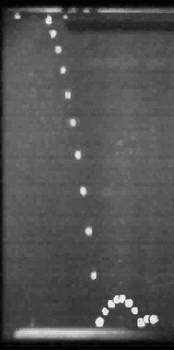
Image: Pacific Northwest National Laboratory researchers armed with a high-speed camera observed that ceramic bb's consistently rebounded about 8 percent of their dropped height from so-called fluffy ice grown at 40 Kelvin; the rebound on the much-higher-temperature ice people encounter on Earth, which is also much more compact, is 80 percent. This cushioning feature of extreme low-temperature ice is a key attribute in planet formation.
Scientists at the Department of Energy's Pacific Northwest National Laboratory, reporting in the current issue of Astrophysical Journal, offer a cool answer to the planet- formation riddle: Micron-wide dust particles encrusted with molecularly gluey ice enabled planets to bulk up like dirty snowballs quickly enough to overcome the scattering force of solar winds.
"People who had calculated the stickiness of dust grains found that the grains didn't stick," said James Cowin, PNNL lab fellow who led the research. "They bounce, like two billiard balls smacked together. The attraction just wasn't strong enough."
Cowin's team has spent years studying, among other things, the chemical and physical properties atmospheric dust and water ice, using an array of instruments suited to the task at the PNNL-based W.R. Wiley Environmental Molecular Sciences Laboratory.
Much of the pre-planetary dust grains were either covered by or largely composed of water ice, having condensed at temperatures close to absolute zero, at 5 to 100 Kelvin. Evidence of this icy solar system can be seen in comets, and planets and moons a Jupiter's distance from its star and beyond are icy.
"This ice is very different from the stuff we chip off our windows in winter," Cowin said. "For example, we saw that at extreme cold temperatures vapor-deposited ice spontaneously becomes electrically polarized. This makes electric forces that could stick icy grains together like little bar magnets."
PNNL staff scientist Martin Iedema, a member of Cowin's group with an astronomy undergraduate degree, surveyed the astrophysics literature and found that the planet growth mystery resided in the same cold temperatures of the lab ices.
Iedema found that the high background radiation in the early solar system would have neutralized a polarized, micron-sized ice grain in days to weeks--or hundreds of thousands of years before it could accrete a critical mass of material and grow to the size of a medicine ball, enabling it to get over the critical size hurdle in planet formation.
But, Iedema said, ice grains colliding into each other would have chipped and broken in two to upset electrical equilibrium and, in essence, recharging the ice grains and restoring their clinginess. Then he discovered an additional feature that gave the sticky ice theory a new bounce.
"More of an anti-bounce," Cowin emended, "from the cushioning, or fluffiness, of this ice. The more technical phrase is 'mechanical inelasticity.' We knew that ice, when grown so cold, isn't able to arrange its molecules in a well-ordered fashion; it becomes fluffy on a molecular scale."
Cowin conjured an image of "billiard balls made of Rice Krispies." Such balls would barely bounce. "Colliding fluffy ice grains would have enough residual electrical forces to make them stick, and survive subsequent collisions to grow into large lumps."
To test this, PNNL postdocs Rich Bell and Hanfu Wang grew ice from the vapor in a chamber that reproduced primordial temperatures and vacuum. They measured bounce by dropping hard, 1/16th- inch hard ceramic balls on it. With a high-speed camera, they observed the balls consistently rebound about 8 percent of their dropped height from fluffy ice grown at 40 Kelvin, whereas on the hard, warmer and much more compact ice that forms naturally on Earth, the ice rebound was as high as 80 percent.
"This huge inelasticity provides an ideal way for fluffy icy grains to stick and grow eventually to protoplanets," Cowin said. Cowin and colleagues further speculate that similar electrical forces, minus the fluffy cushioning, were at work during the infancy of hotter inner planets like Earth, involving silicate dust grains instead of ice.
Source: DOE/Pacific Northwest National Laboratory


