LHC magnets: the great descent
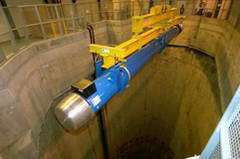
The first superconducting magnet for the Large Hadron Collider (LHC) was lowered into the accelerator tunnel at 2.00 p.m. on Monday, 7th March. This is the first of the 1232 dipole magnets for the future collider, which measures 27 km in circumference and is scheduled to be commissioned in 2007. The date was thus a key one for CERN since the delivery of the 15 metre long dipole magnet weighing 35 tonnes to its final location marks the start of LHC installation.
The LHC will consist predominantly of superconducting dipole magnets, which are the most complex components of the machine. Their superconducting coil allows them to convey extremely high currents without any loss of energy. They are therefore able to produce very high magnetic fields in order to bend the trajectory of the protons that are accelerated at a speed close to the speed of light. The LHC will thus be the world's most powerful accelerator. The collisions between the protons will reach energies of 14 teraelectronvolts (TeV), 70 times higher than those of the former LEP collider for which the 27 km tunnel was originally built. To reach the superconducting state, the magnets have to be cooled to a temperature of -271°C, close to absolute zero. If the LHC had been made of conventional magnets, it would have needed to be 120 km long to achieve the same energies and its electricity consumption would have been phenomenal.
These superconducting magnets will all be lowered 50 metres down below the earth's surface via a specially made shaft of oval cross-section. They will then be conveyed through a transfer tunnel to the LHC tunnel, which lies at a depth varying between 50 and 150 metres. Vehicles travelling at 3 km an hour have been specially designed to deliver the magnets to their final destination. The narrowness of the tunnel complicates these handling operations, making it impossible, for example, for two loads to pass each other.
In addition to the dipole magnets, the LHC will be equipped with hundreds of other, smaller magnets. More than 1800 magnet assemblies will have to be installed. Once in position, the magnets will be connected to the cryogenic system to form a large string operating in superfluid helium, which will maintain the accelerator at a temperature close to absolute zero.
The lowering of this first magnet into the tunnel coincides with another milestone for CERN, namely completion of the delivery of half the superconducting dipole magnets. A total of 616 magnets have been delivered to date, and the same number are due to arrive by autumn 2006. The manufacture of these superconducting magnets represents a huge technical and industrial challenge both for CERN and for European industry. 7000 kilometres of niobium-titanium superconducting cable have had to be produced to make them. Around a hundred companies in Europe are manufacturing the magnet components, and three companies, Babcock Noell Nuclear in Germany, Alstom in France, and Ansaldo in Italy, are responsible for their assembly. The greatest challenge was the move from the prototyping and pre-series phase to large-scale series production, which involved much ground-breaking technology. Success has been achieved, with three industrial sites now able to manufacture between nine and ten magnets a week.
Source: CERN


