New view of secret space blobs
Jan 28, 2005
New view of secret space blobs

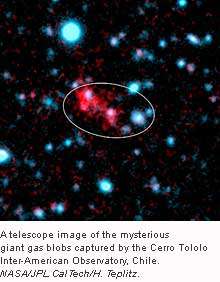
Most objects in space have been catalogued, numbered and named, but one type of mysterious object has yet to be classified — and they are known simply as ‘blobs’.
Blobs are enormous clouds of intensely glowing gas, floating deep in space. Until now, astronomers thought that these gas clouds were empty — with nothing solid inside them. They were baffled at how such enormous gas clouds could exist, and glow so brightly, without having some power source within them.

A group of scientists including ANU astrophysicist Dr Paul Francis has today released new evidence about the blobs. They used NASA’s powerful new Spitzer Space Telescope to reveal that the blobs, far from being empty gas clouds, actually contain colliding groups of some of the brightest and most violent galaxies in the universe.

"With normal telescopes, these gas clouds look empty,” said Dr Francis. “But Spitzer uses infra-red light to penetrate the obscuring clouds of interstellar dust and reveal the hidden galaxies within. They are whoppers — each blob seems to contain two or three massive colliding galaxies, each of which is as bright as 10 trillion suns!”

Blobs are made up of hot hydrogen gas and are the biggest gas clouds in the known universe, being about 100 million times as large as a typical galaxy. Astronomers first noticed the glowing phenomena 10 years ago, but have not yet worked out where the gas comes from or what provides the energy to light them up.

“It now seems that most blobs contain massive colliding galaxies,” said Dr Harry Teplitz, from NASA’s Spitzer Science Center. “The collisions seem to be turning these galaxies into immense stellar nurseries — they are forming about one new star every single day. We would expect some of these new stars to explode — the blast waves from these stars could be producing the blobs. But we’ll need more observations to be sure.”

"Far from solving the mystery of the blobs, these observations only deepen it. Not only are the gas clouds bizarre, we now know that they contain some of the brightest and most violent galaxies in the universe," Dr Francis said.

These blobs lie at a distance of 10.8 billion light-years from Earth and were first discovered by Dr Francis using a combination of the Anglo-Australian Telescope, located at Siding Spring Observatory in New South Wales, and the Blanco Telescope, located at Cerro Tololo Interamerican Observatory, in Chile.

The research team includes Dr James Colbert from the California Institute of Technology; Dr Povilas Palunas, from the University of Texas; Dr Gerard Williger, from Johns Hopkins University; and Dr Bruce E. Woodgate, from NASA's Goddard Space Flight Center.

NASA's Jet Propulsion Laboratory, in Pasadena, California, manages the Spitzer Space Telescope mission for NASA's Science Mission Directorate, in Washington, D.C. Science operations are conducted at the Spitzer Science Center.

Source: Australian National University

Explore further: Chinese, Indian airlines face EU pollution fines

add to favorites email to friend print save as pdf

Related Stories

Discovery of a blue supergiant star born in the wild

Apr 11, 2013

A duo of astronomers, Dr. Youichi Ohyama (Institute of Astronomy and Astrophysics, Academia Sinica or ASIAA, Taiwan) and Dr. Ananda Hota (UM-DAE Centre for Excellence in the Basic Sciences or CBS, India), ...

Hubble gazes on one ring to rule them all

Mar 18, 2013

(Phys.org) —Galaxies can take many forms—elliptical blobs, swirling spiral arms, bulges, and disks are all known components of the wide range of galaxies we have observed using telescopes like the NASA/ESA ...

Gravitational telescope creates space invader mirage

Mar 05, 2013

(Phys.org)—The NASA/ESA Hubble Space Telescope is one of the most powerful available to astronomers, but sometimes it too needs a helping hand. This comes in the form of Einstein's general theory of relativity, ...

Exocomets may be as common as exoplanets

Jan 07, 2013

(Phys.org)—Comets trailing wispy tails across the night sky are a beautiful byproduct of our solar system's formation, icy leftovers from 4.6 billion years ago when the planets coalesced from rocky rubble.

A one-way street for spinning atoms

Aug 30, 2012

Elementary particles have a property called "spin" that can be thought of as rotation around their axes. In work reported this week in the journal Physical Review Letters, MIT physicists have imposed a stri ...

Recommended for you

Mars rover Opportunity examines clay clues in rock

5 hours ago

(Phys.org) —NASA's senior Mars rover, Opportunity, is driving to a new study area after a dramatic finish to 20 months on "Cape York" with examination of a rock intensely altered by water.

Chinese, Indian airlines face EU pollution fines

9 hours ago

Eight Chinese and two Indian airlines face fines of up to several million euros for not paying for their greenhouse gas emissions during flights within the bloc, the European Commission said on Friday.

Alaska volcano shoots ash 15,000 feet into the air

9 hours ago

(AP)—One of Alaska's most restless volcanoes has shot an ash cloud 15,000 feet into the air in an ongoing eruption that has drawn attention from a nearby community but isn't expected to threaten air traffic.

NASA's STEREO detects a CME from the sun

18 hours ago

On 5:24 a.m. EDT on May 17, 2013, the sun erupted with an Earth-directed coronal mass ejection or CME, a solar phenomenon that can send billions of tons of solar particles into space that can reach Earth ...

NASA sees Cyclone Mahasen hit Bangladesh

21 hours ago

NASA's Tropical Rainfall Measuring Mission satellite known as TRMM measured Cyclone Mahasen's rainfall rates from space as it made landfall on May 16. Mahasen has since dissipated over eastern India.

User comments : 0

More news stories

Alaska volcano shoots ash 15,000 feet into the air

(AP)—One of Alaska's most restless volcanoes has shot an ash cloud 15,000 feet into the air in an ongoing eruption that has drawn attention from a nearby community but isn't expected to threaten air traffic.

Chinese, Indian airlines face EU pollution fines

Eight Chinese and two Indian airlines face fines of up to several million euros for not paying for their greenhouse gas emissions during flights within the bloc, the European Commission said on Friday.

NASA's STEREO detects a CME from the sun

On 5:24 a.m. EDT on May 17, 2013, the sun erupted with an Earth-directed coronal mass ejection or CME, a solar phenomenon that can send billions of tons of solar particles into space that can reach Earth ...

New colonoscope provides ground-breaking view of colon

A ground-breaking advance in colonoscopy technology signals the future of colorectal care, according to research presented today at Digestive Disease Week(DDW). Additional research focuses on optimizing the minimal withdrawal ...

Yahoo Japan suspects 22 million IDs stolen

Yahoo Japan Corp. has said it suspects up to 22 million user IDs may have been stolen during an unauthorised attempt to access the administrative system of its Yahoo! Japan portal.

US seizes Bitcoin operator accounts

US authorities seized the accounts of a Bitcoin digital currency exchange operator, claiming it was functioning as an "unlicensed money service business," court documents showed Friday.