Discovery explains how the venus flytrap snaps
A team of applied mathematicians, physicists, and biologists has discovered how the Venus flytrap snaps up its prey in a mere tenth of a second by actively shifting the curved shape of its mouth-like leaves. Their study, published in the Jan. 27 issue of the journal Nature, investigates the series of events that occur from the time the plant's leaves are stimulated to the time the trap is clamped shut.
The Venus Flytrap is the most famous of all carnivorous plants. Most early scientists believed the plant to be a myth until there was physical proof. Carnivorous plants occur naturally is swampy, marshy areas. The plant mostly lives in North and South Carolina along the coastal plain. One of the more dramatic plant movements is the snapping shut of the leaf of a Venus Flytrap when it detects movement on its surface.
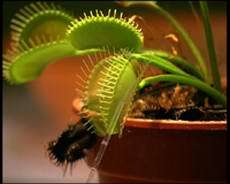
Image: Superposition of the open and closed leaves of the Venus flytrap. The glass needle in the foreground was used to trigger the closure. Note that the leaves flip by almost turning inside out - similar to the flipping of a contact lens, plastic lid or the reversal of a torn tennis ball. Courtesy of Forterre and Mahadevan.
"Our work complements prior research," says Lakshminarayanan Mahadevan, Gordon McKay Professor of Applied Mathematics and Mechanics in Harvard University's Division of Engineering and Applied Sciences and affiliate in the Department of Organismic and Evolutionary Biology in Harvard's Faculty of Arts and Sciences. "In addition to looking at biochemical events, we looked at what happened after the plant was stimulated and found that the rapid closing is due to a 'snap-buckling instability' that the plant itself controls."
To trap its prey, the carnivorous plant relies on both an active biochemical and a passive elastic process, say Mahadevan and former students and postdocs Yoлl Forterre, Jan M. Skotheim, and Jacques Dumais. When an insect brushes up against a hair trigger, the plant responds by moving water to actively change the curvature of its leaves. While exactly how the water is moved is not completely understood, the scientists observed that the deformation of the leaves, once stimulated, provided the means by which elastic energy was stored and released, creating a simple yet effective jaw-like movement.
"In essence, a leaf stretches until reaching a point of instability where it can no longer maintain the strain," Mahadevan says. "Like releasing a reversed plastic lid or part of a cut tennis ball, each leaf folds back in on itself, and in the process of returning to its original shape, ensnares the victim in the middle. The hydrated nature of the leaf quickly dampens the vibrations caused by the movement, so the unlucky bug doesn't spill out. It then takes the plant up to eight hours to ready its leaves for the next unsuspecting bug."
To reveal how the Venus flytrap snaps, the researchers painted ultraviolet fluorescent dots on the external face of the leaves and filmed them under ultraviolet light using high-speed video. By using mirrors to record stereo images of the process, they were able to reconstruct the geometry of the leaf. Finally, a simple mathematical model provided them with a way to understand the quantitative and qualitative aspects of snapping such as when the plant snaps, how long it takes before it goes into action once stimulated, and how fast the entire process happens.
"Our explanation relied on interplay between theory and experiment, and on the interdisciplinary interests and nature of our group, with expertise ranging from applied math and physics to biology," Mahadevan says.
In addition to shedding light on an age-old riddle involving a plant Charles Darwin called "one of the most wonderful in the world," the discovery has implications for biomimetic systems. One day, engineers might be able to emulate the plant's ingenious alternative to muscle-powered movements in tiny artificial devices, such as those that control the flow of minute amounts of liquids or gases. Common applications that already use related technology include valves and switches in microfluidic devices, hydraulic sensors and actuators and timed-release drug delivery mechanisms.
Prior explanations of Venus flytrap operation have cited a loosening of cell walls combined with a quick loss of cellular pressure, but it had not been clear how these cellular mechanisms alone could produce the lightning-fast closure of the entire leaf.
Source: Harvard University


