Nanoscale electron island could lead to new efficient flat-panel displays
Jan 18, 2005
Nanoscale electron island could lead to new efficient flat-panel displays

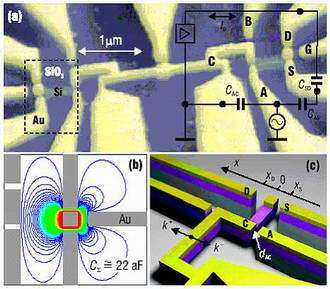
UW-Madison Electrical and Computer Engineering Associate Professor Robert Blick and colleagues in Germany have demonstrated a new nanoscale mechanism for field emission that could lead to a new type of energy efficient flat-panel display. The team's article in Physical Review Letters describes how a nanoscale gold-tipped island is able to mechanically oscillate between two facing electrodes, which provide recharging and detection of the emission current. Additionally, unlike many nanoscale experiments in field emission, the device does not need to be cryogenically cooled.

Image caption: see below.

Field emission, also called Fowler-Nordheim tunneling, is the process in which electrons tunnel through a barrier in the presence of a high electric field. This quantum mechanical tunneling process is an important mechanism for thin barriers such as those in metal-semiconductor junctions on highly-doped semiconductors. With its nanoscale device, the team is able to trace and reproduce the transition from current flow through a rectangular tunneling barrier to the regime of field emission.

"Field emission from microscopic tips has been a fundamental tools of experimental physics for decades, and nanoscale emitters are the subject of intense research" explains Blick. "However, contrary to earlier observed deviation from the Fowler-Nordheim, our isolated nanomechanical pendulum shows new behavior already at low voltages. The fact that the emitter is isolated alters the Fowler-Nordheim description to a behavior which becomes linear for large voltages."

The team will continue its research with the goal of understanding how field emission is performed in a controlled fashion, one electron at a time.

Image caption: (a) SEM micrograph of the device with two nanomechanical diodes. The right hand shuttle cantilever C is seen with gates A through S. The equivalent circuit of the setup is superimposed: the ac voltage is applied to gate A where it couples via CAS to the source S. The island is excited via the resulting resonant Coulomb force, and transferred electrons are detected at drain D. The amplifier's output is recorded vs frequency f of the ac voltage. (b) Finite element simulation of the electrostatic potential for a charged island and grounded surrounding. The island's overall capacitance C = 22 aF determines the energy required for charge transfer to the island. (c) Schematic of the nanomechanical diode featuring geometrical details and definitions, including the mechanical asymmetry of the spring constant k. The metallic island dimensions are 80x80x50 nm3.

Source: University of Wisconsin-Madison

Explore further: Researchers perform fastest measurements ever made of ion channel proteins

add to favorites email to friend print save as pdf

Related Stories

NASA Goddard astrophysicist wins prize for pulsar work

Feb 04, 2013

To say that Alice Harding, an astrophysicist at NASA's Goddard Space Flight Center in Greenbelt, Md., has a passion for pulsars is a bit of an understatement. On Jan. 24, she was named a winner of the 2013 ...

US defends 'enormous' climate efforts at UN talks

Nov 26, 2012

(AP)—Anticipating an onslaught of criticism from poor nations, the United States claimed "enormous" strides in reducing greenhouse emissions at the opening of U.N. climate talks Monday, despite failing ...

Recommended for you

Advance in nanotech gene sequencing technique

10 hours ago

(Phys.org) —The allure of personalized medicine has made new, more efficient ways of sequencing genes a top research priority. One promising technique involves reading DNA bases using changes in electrical ...

Engineers' nanoantennas improve infrared sensing

15 hours ago

(Phys.org) —A team of University of Pennsylvania engineers has used a pattern of nanoantennas to develop a new way of turning infrared light into mechanical action, opening the door to more sensitive infrared ...

Kinks and curves at the nanoscale

May 19, 2013

One of the basic principles of nanotechnology is that when you make things extremely small—one nanometer is about five atoms wide, 100,000 times smaller than the diameter of a human hair—they are going ...

User comments : 0

More news stories

Engineers' nanoantennas improve infrared sensing

(Phys.org) —A team of University of Pennsylvania engineers has used a pattern of nanoantennas to develop a new way of turning infrared light into mechanical action, opening the door to more sensitive infrared ...

Advance in nanotech gene sequencing technique

(Phys.org) —The allure of personalized medicine has made new, more efficient ways of sequencing genes a top research priority. One promising technique involves reading DNA bases using changes in electrical ...

Lab sets a new record for creating heralded photons

(Phys.org) —Entanglement, by general consensus of physicists, is the weirdest part of quantum science. To say that two particles, A and B, are entangled means that they are actually two parts of an inseparable ...

Protein study suggests drug side effects are inevitable

A new study of both computer-created and natural proteins suggests that the number of unique pockets – sites where small molecule pharmaceutical compounds can bind to proteins – is surprisingly small, meaning drug side ...

Do salamanders hold the solution to regeneration?

Salamanders' immune systems are key to their remarkable ability to regrow limbs, and could also underpin their ability to regenerate spinal cords, brain tissue and even parts of their hearts, scientists have ...