High-Tech X-Ray Equipment to Examine Dinosaur Skull
Jan 14, 2005
NASA Uses High-Tech X-Ray Equipment to Examine Dinosaur Skull

As NASA charts a bold new course into the future, the space agency is briefly taking a step back in time to examine a dinosaur skull.
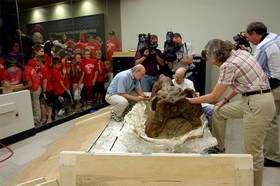
NASA scientists are using equipment at the Marshall Space Flight Center in Huntsville, Ala., to scan the skull of a Tyrannosaurus rex. The state-of-the-art equipment was originally designed to examine rocket motor assemblies and turbine blades. Discovered on a South Dakota ranch in 1992, it is believed to be the most complete and well-preserved T-rex skull ever discovered.

Discoverers dubbed the find "Samson," recognizing the beast's reputation as the strongest dinosaur to roam the Earth during the late Cretaceous period. "Marshall is one of the few places in the world with the technology needed for such a complex scan," said Dr. Chris Beard, curator of vertebrate paleontology at the Carnegie Museum of Natural History in Pittsburgh. "We are very excited NASA has agreed to provide space-age technology for this project."

Dr. Ron Beshears is leading the project at the National Center for Advanced Manufacturing located at the Marshall Center. Beshears' laboratory team is running various tests on the skull with a high-tech computed tomography scanner used for nondestructive testing of parts and equipment destined for space. The scans provide Carnegie Museum experts with detailed cross-section images of the skull. Such detail will help museum experts better understand the basic anatomy and lifestyle of the T-rex.

"The idea of working with 65 million year old dinosaur bones alongside next-generation space technologies is something we're quite excited about," Beshears said. "We're happy we can use our facility to assist in a scientific investigation of the dinosaur fossil."

The fossil arrived at Marshall Dec. 1, and tests will continue for several weeks. Carnegie Museum researchers will use results to compare Samson's skull with previous computed tomography scans of less well-preserved T-rex fossils, establishing a baseline to determine anomalies in future finds. Although privately owned, Samson is being prepared and studied by the museum for two-years. The dinosaur arrived at the Carnegie in May 2004.

The skull, separated from its skeleton by the museum for study, is largely encrusted in rock. It arrived at Marshall enclosed in a shipping crate approximately 5 feet by 3.5 feet and weighing approximately 1,600 pounds. Because of the skull's fragility, it will not be removed from the crate while tests are performed. After tests and examinations are completed, it will be returned to the Carnegie to recreate the once-fearsome predator.

Source: NASA

Explore further: Mais non! French universities may teach in English

add to favorites email to friend print save as pdf

Related Stories

Scientists reveal new species of dog-sized dinosaur

May 07, 2013

Scientists have named a new species of bone-headed dinosaur (pachycephalosaur) from Alberta, Canada. Acrotholus audeti (Ack-RHO-tho-LUS) was identified from both recently discovered and historically collec ...

New quest to study 'living fossil' coelacanth

Mar 29, 2013

French and South African biologists will dive to deep-sea caves in the Indian Ocean next month in a bid to locate the coelacanth, the "living fossil" fish whose history predates the dinosaurs, France's National ...

Seeing inside a pterosaur skull

Mar 22, 2013

(Phys.org) —The inside of the skull of a 100-million-year-old pterosaur has been seen by Natural History Museum fossil experts for the first time. Computed tomography (CT) scans revealed details of the ...

The brain of the ampelosaur from Spain revealed in 3D

Jan 23, 2013

The remains of the ampelosaur found in 2007 in the site of Lo Hueco (Cuenca) have allowed the 3D reconstruction of the brain of this animal, according to an investigation in which the Spanish National Research ...

Recommended for you

Submerged structure stumps Israeli archaeologists

6 hours ago

The massive circular structure appears to be an archaeologists dream: a recently discovered antiquity that could reveal secrets of ancient life in the Middle East and is just waiting to be excavated.

Mais non! French universities may teach in English

20 hours ago

In France, there's a brewing debate over whether to speak anglais in universite. The National Assembly on Wednesday was taking up an education reform bill that would allow public universities to hold some courses—like science ...

User comments : 0

More news stories

Submerged structure stumps Israeli archaeologists

The massive circular structure appears to be an archaeologists dream: a recently discovered antiquity that could reveal secrets of ancient life in the Middle East and is just waiting to be excavated.

Mais non! French universities may teach in English

In France, there's a brewing debate over whether to speak anglais in universite. The National Assembly on Wednesday was taking up an education reform bill that would allow public universities to hold some courses—like science ...

A hidden population of exotic neutron stars

(Phys.org) —Magnetars – the dense remains of dead stars that erupt sporadically with bursts of high-energy radiation - are some of the most extreme objects known in the Universe. A major campaign using ...

The secret lives, and deaths, of neurons

As the human body fine-tunes its neurological wiring, nerve cells often must fix a faulty connection by amputating an axon—the "business end" of the neuron that sends electrical impulses to tissues or other ...