The Chip Printers - Integrated Circuits Made of Plastic
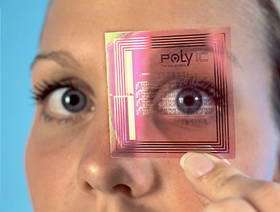
The PolyIC company has taken a giant step toward realizing the mass production of RFID chips made of plastic: The developers have created the world’s fastest (600 kilohertz) integrated circuit made of organic material. What’s more, they have succeeded in using printing techniques to produce highly stable circuits made of polymers, something no other group of researchers in the world has achieved, according to information released by PolyIC. The distance between the two conductors is less than 50 micrometers, about as thin as a human hair. These chips even function after being stored for two days at a temperature of 60 degrees Celsius and at 100 percent humidity, and will continue to work until temperatures climb above 120 degrees Celsius.
Based in Erlangen, Germany, the start-up company is a joint venture between Siemens Automation and Drives and Leonhard Kurz GmbH & Co. KG, a leading manufacturer of stamping foils.
PolyIC is relying on a revolutionary production technology. The idea is to print the circuits onto foil — the same way a newspaper is printed on paper. Over the long term, production costs of less than one cent per chip are possible. The company intends to use this technology to realize its ambitious goal of replacing the bar code, which usually only contains a type designation, with electronic chips made of plastic.
These “intelligent tags” should eventually make it possible to differentiate between individual product items. Affixed to products, the radio chips are opening up new possibilities in terms of delivery, inventory management and labeling of goods, because they can be read from a distance. Another conceivable application for this technology is the automatic checkout line, where customers would simply move their shopping carts past a radio scanner that automatically registers everything in the cart.
There is a tremendously broad spectrum of possible applications for the plastic chips. The first products, which should be available in 2006, can be used as forgery-proof labels, as the research magazine Pictures of the Future recently reported. To replace bar codes, PolyIC intends to gradually produce more complex circuits with several thousand transistors and up to 128 bits of memory. Today’s bar codes typically can store 44 bits.
