'Nano-scissors' laser shows precise surgical capability
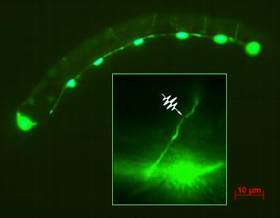
An ultra-short pulse laser that can perform extremely precise surgery on tiny roundworms may be the key to understanding nerve regeneration and is an important step toward treatment of human neurological disease, according to research published in the Dec. 16 issue of Nature.
Dr. Adela Ben-Yakar, an assistant professor of mechanical engineering at The University of Texas at Austin, led the development of the technique. It acts like a pair of tiny "nano-scissors," able to cut, for example, nano-sized units like nerve axons, the parts of nerve cells that carry nerve impulses away from the cells to muscles or to other cells.
Image: The background shows a C. elegans roundworm. The bright green dots are neurons, and the thin green lines extending from the neurons are axons. The inset demonstrates where the laser severs the axon. Photo: H. Cinar and Y. Jin
“This tool opens up a new frontier for biologists studying nerve regeneration,” says Ben-Yakar. “We can also apply it to many other studies that require nanosurgery, so it’s a very versatile tool.”
The beauty of this laser, she says, is its ability to cut organelles (parts of cells—they are what organs are to organisms) precisely, without damaging surrounding tissue. Usually, conventional lasers used in surgery heat the area to be cut, then cut it, but this heightens the risk for tissue damage.
Ben-Yakar’s nanosurgery technique used a series of low-energy “femtosecond” laser pulses to partially sever the axons of several anesthetized C. elegans, a widely studied type of roundworm about one millimeter long. A femtosecond is one millionth of a billionth of a second.
“The time is very important here,” she says. “Because it happens so fast, there isn’t enough time for heat to diffuse out, so we don’t damage anything. The pulse’s very short length makes the photons in the laser concentrate in one area, delivering a lot of power to a tiny, specific volume without damaging surrounding tissue.”
Once cut, the axons vaporized, and no other tissue was harmed.
To assure the axons were actually cut, and their disappearance wasn’t caused by discoloration by the laser, the researchers cut axons they knew would impair the worms’ backward motion. The worms couldn’t move backwards after surgery. But within 24 hours, most of the severed axons regrew and the worms recovered backward movement—confirming that the precision of the laser’s cut didn’t damage surrounding tissue and allowed the neurons to grow a new axon to reach the muscle.
Until now, researchers have only been able to investigate nerve regeneration in mice and zebrafish, which have complex nervous systems. This laser allows researchers to study nerve cells at their most basic evolutionary form, opening the door to other experiments on genetic and molecular factors that determine whether damaged nerve cells regrow.
Ben-Yakar developed the femtosecond laser surgery technique using the laboratories and equipment of Dr. Robert Byer, a Stanford University professor, while doing post-doctoral work. The paper’s other co-authors are Mehmet Fatih Yanik at Stanford, Hulusi Cinar, Hediye Nese Cinar and Andrew D. Chisholm at the University of California at Santa Cruz and Yishi Jin of UC Santa Cruz and the Howard Hughes Medical Institute.
-
From lemons to lemonade: Reaction uses carbon dioxide to make carbon-based semiconductor,
32 comments
-
Thioridazine kills cancer stem cells in human while avoiding toxic side-effects of conventional cancer treatments,
3 comments
-
SpaceX private rocket blasts off for space station (Update),
42 comments
-
Climate scientists say they have solved riddle of rising sea,
31 comments
-
SpaceX capsule has 'new car' smell, astronauts say (Update),
4 comments
More news stories
'Unzipped' carbon nanotubes could help energize fuel cells, batteries
Multi-walled carbon nanotubes riddled with defects and impurities on the outside could replace some of the expensive platinum catalysts used in fuel cells and metal-air batteries, according to scientists at ...
Nanotechnology / Nanomaterials
10 hours ago |
3 / 5 (2) |
0
|
Stunning image of smallest possible five-ringed structure
Scientists have created and imaged the smallest possible five-ringed structure about 100,000 times thinner than a human hair and you'll probably recognise its shape.
4 hours ago |
4.4 / 5 (5) |
1
|
Dopant gives graphene solar cells highest efficiency yet
(Phys.org) -- By taking advantage of graphenes favorable electrical and optical properties, and then adding an organic dopant, researchers have achieved the highest power conversion efficiency yet for ...
In nanorod crystal growth, nanoparticles seen as artificial atoms
In the growth of crystals, do nanoparticles act as "artificial atoms" forming molecular-type building blocks that can assemble into complex structures? This is the contention of a major but controversial theory ...
May 24, 2012 |
4.8 / 5 (6) |
0
|
First direct observation of oriented attachment in nanocrystal growth
Berkeley Lab researchers have reported the first direct observation of nanoparticles undergoing oriented attachment, the critical step in biomineralization and the growth of nanocrystals. A better understanding ...
May 24, 2012 |
4.7 / 5 (3) |
0
|
Change in developmental timing was crucial in the evolutionary shift from dinosaurs to birds: study
At first glance, it's hard to see how a common house sparrow and a Tyrannosaurus Rex might have anything in common. After all, one is a bird that weighs less than an ounce, and the other is a dinosaur that ...
Computer model used to pinpoint prime materials for efficient carbon capture
When power plants begin capturing their carbon emissions to reduce greenhouse gases and to most in the electric power industry, it's a question of when, not if it will be an expensive undertaking.
T cells 'hunt' parasites like animal predators seek prey, study shows
By pairing an intimate knowledge of immune-system function with a deep understanding of statistical physics, a cross-disciplinary team at the University of Pennsylvania has arrived at a surprising finding: T cells use a movement ...
Land and sea species differ in climate change response: study
(Phys.org) -- Marine and terrestrial species will likely differ in their responses to climate warming, new research by Simon Fraser University and Australia’s University of Tasmania has found.
Yale study concludes public apathy over climate change unrelated to science literacy
Are members of the public divided about climate change because they don't understand the science behind it? If Americans knew more basic science and were more proficient in technical reasoning, would public consensus match ...
10 million years needed to recover from mass extinction
It took some 10 million years for Earth to recover from the greatest mass extinction of all time, latest research has revealed.