Disappearing in dry quicksand
Dec 23, 2004
Disappearing in dry quicksand

People and even vehicles disappearing in the desert: they are popular myths of desert travelers. In famous books writers like T.E. Lawrence, 'Lawrence of Arabia', let these things happen. They could be more realistic than readers would assume, according to research of prof. Detlef Lohse and his Physics of Fluids group at the University of Twente (Netherlands). They report about 'dry quicksand' in 9 December's issue of Nature.

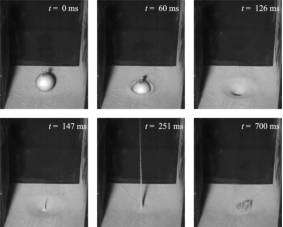
Image: Six snapshots from a high speed image recording: The snapshots correspond to (a) ball release, (b) sinking, (c) disappearing, (d) void collapse, (e) jet, and (f) granular eruption.

Lohse and his researchers Remco Rauhé, Raymond Bergmann and Deveraj van der Meer created something they call ‘dry quicksand’. Sand is usually able to support weight relying on internal force chains. The well known quicksand is a mixture with force chains that are substantially weaker. In other words: it is possible to influence the 'support capabilities' of sand.

To create dry quicksand, the scientist filled a container with very fine grain sand (grains of about 0,04 millimetres). The bottom of the container has holes in it, through which air is blown. When the stream of air is closed off, the grains move down to form a very loose packing (just 41 vol percent).

Touching the surface of the sand, the researcher hung a four centimetre pingpong ball on a thin rope. The ball was filled with tiny bronze balls to be able to vary the weight. After the rope is burnt, the ball falls into the sand in one movement. Without any effort, it moves through the sand. The researchers measured the depth by attaching a vertical tail –almost without mass- to the ping pong ball.

Source: University of Twente

Explore further: Promising doped zirconia

add to favorites email to friend print save as pdf

Related Stories

Recommended for you

Promising doped zirconia

May 17, 2013

Materials belonging to the family of dilute magnetic oxides (DMOs)—an oxide-based variant of the dilute magnetic semiconductors—are good candidates for spintronics applications. This is the object of ...

Bringing life into focus

May 17, 2013

Spinning-disk confocal microscopy is an optical imaging technique that can be used to generate detailed three-dimensional fluorescence images of living cells and their contents. Although a powerful tool for ...

Nanocrystals grow from liquid interface

May 17, 2013

An international collaboration of scientists has discovered a unique crystalizing behavior at the interface between two immiscible liquids that could aid in sustainable energy development.

User comments : 0

More news stories

New principle may help explain why nature is quantum

Like small children, scientists are always asking the question 'why?'. One question they've yet to answer is why nature picked quantum physics, in all its weird glory, as a sensible way to behave. Researchers ...

Manipulating Lorentz and Fano spectral line shapes

(Phys.org) —It is widely known that the optical properties of certain materials can be modified by using lasers to control the quantum states of their optical electrons. Lasers that can generate ultra-short ...

Galaxy's Ring of Fire

Johnny Cash may have preferred this galaxy's burning ring of fire to the one he sang about falling into in his popular song. The "starburst ring" seen at center in red and yellow hues is not the product of ...

New colonoscope provides ground-breaking view of colon

A ground-breaking advance in colonoscopy technology signals the future of colorectal care, according to research presented today at Digestive Disease Week(DDW). Additional research focuses on optimizing the minimal withdrawal ...