A new unidentified very high energy gamma-ray source in our Galaxy
A European team based in Heidelberg (Germany) and their colleagues from the HEGRA collaboration have discovered a new, unidentified, very high energy gamma-ray source in our Galaxy. This source was detected via ground-based observations of the Imaging Atmosphere Cherenkov Telescope System.
This system of five telescopes is designed to detect the light produced when high energy particles enter the Earth’s atmosphere. The discovery of this source, TeV J2032+4130, is of particular interest because there are only a few very high energy sources in our Galaxy; most of them lie outside our Galaxy.
Additionally, this source does not show any counterpart at other wavelengths, notably at X-ray wavelengths. This team was also involved in the recent discovery of a similar unidentified source, suggesting the emergence of a new class of high energy gamma-ray sources of unknown nature.
During the last ten years, several ground-based observatories dedicated to very high energy gamma-ray detection have been built. They are designed to detect the light produced when very high energy gamma rays interact with the Earth’s atmosphere. Particles that travel in the Earth’s atmosphere faster than the speed of light in air (that is a bit lower than the speed of light in vacuum) produce so-called Cherenkov radiation. Cherenkov light is made of fast and faint blue flashes. This effect is analogous to the supersonic bang that occurs when a plane travels faster than the speed of sound.
Cherenkov light is produced by very high energy particles such as cosmic rays or gamma rays that enter the Earth’s atmosphere. Specialized telescopes that detect the Cherenkov light and infer information about the incoming cosmic rays and gamma-ray photons, have been built during the past few years. Cosmic rays and gamma rays can be distinguished because, unlike gamma rays, cosmic rays reach the Earth’s atmosphere evenly from all directions.
As charged particles, cosmic rays are deflected by galactic and intergalactic magnetic fields during their travel to Earth. On the contrary, gamma rays are uncharged particles: they are not deflected by magnetic fields and follow a straight path to Earth. By checking whether a given Cherenkov flash comes from a single direction or from all directions, one can distinguish whether it is produced by cosmic rays or by gamma rays. Additionally, as gamma rays are not deflected, they point directly to their source, which may thus be identified.
About ten years ago, the High Energy Gamma-Ray Astronomy (HEGRA) collaboration, made up of German, Spanish and Armenian teams, built the stereoscopic Imaging Atmosphere Cherenkov Telescope System, dedicated to the detection of high energy gamma rays by the intermediary of the Cherenkov effect. Now dimantled, this system was made up of five identical telescopes and was designed to detect gamma ray events rather than cosmic rays events. It was the first time that such a system was built to observe gamma ray events using stereoscopic techniques: the five telescopes view the same events from slightly different angles. This technique yields an improved reconstruction of the initial gamma-ray particle entering the atmosphere. The system was able to identify the direction of the incoming gamma ray with a precision better than 0.1°.
Using the HEGRA Imaging Atmosphere Cherenkov Telescope System, F. Aharonian (Heidelberg, Germany) and the HEGRA collaboration have now confirmed the discovery of a new high energy gamma-ray source that was made a few years ago. This source is named “TeV J2032+4130”. “TeV” refers to the energy level of the source; it is an abbreviation for teraelectronvolt. It means that the energy of the source is of the order of a teraelectronvolt, that is, a trillion (1012) electronvolts. The number “J2032+4130” refers to the position of the source in the sky. The gamma-ray photons emitted by this source are among the most energetic photons ever observed. The energy of TeV gamma-ray photons is compared to photons at other wavelengths in the chart below.
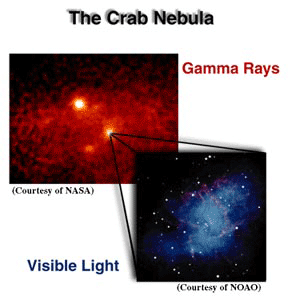
The source TeV J2032+4130 has very interesting features. It is most likely located within our own Galaxy, which is remarkable since there are only a few very high energy gamma ray sources in our Galaxy. The centre of our Galaxy is a famous gamma ray source. Another well-known source is the Crab Nebula (see right picture), the remnant of a supernova explosion. In both cases, the corresponding sources also have strong emission at X-ray wavelengths, suggesting the presence of accelerated electrons.
On the contrary, TeV 2032+4130 does not show any counterpart at other wavelengths, notably at X-ray energies. The lack (or at least the low level) of X-ray emission of TeV 2032+4130 suggests that the gamma ray emission arises from the interaction of accelerated cosmic rays with the local ambient matter.
TeV J2032+4130 is located in the Cygnus region, an extremely active star-formation region. It contains a large number of X-ray and low energy gamma-ray sources. To explain the gamma rays emitted by TeV J2032+4130, the HEGRA collaboration looked for sites in this region that could accelerate cosmic ray particles to high enough energy. Such sites could be supernova remnants, expanding clouds of gas that represent the outer layers of exploded stars named supernovae. However, no such supernova remnant has been identified yet in this region. The team believes that TeV J2032+4130 might be related to the “OB stellar association” Cygnus OB2. An OB association is a grouping of very hot and massive young stars. Such an association is named “OB” because these stars have O and B spectral types. Cygnus OB2 is thought to be powering the entire region via the intense stellar winds emanating from its stars.
The detection of the source TeV J2032+4130 over long observation times (about 200 hours) by HEGRA demonstrated the power of the stereoscopic technique for the ground-based detection of very high energy gamma rays. The next generation of ground-based instruments should be able to detect similar sources within only a few hours. One of these new generation instruments, the High Energy Stereoscopic System (HESS), resulting from an international collaboration and inaugurated earlier this year, recently revealed a similar unidentified TeV source. This second discovery suggests that a new class of high energy gamma-ray source of unknown nature might emerge as technology improves.


