Researchers Develop Efficient Organic Solar Cell
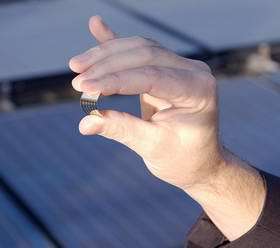
As the price of energy continues to rise, businesses are looking to renewable energy for cheaper sources of power. Making electricity from the most plentiful of these sources - the sun - can be expensive due to the high price of producing traditional silicon-based solar cells. Enter organic solar cells. Made from cheaper materials, their flexibility and feather-weight construction promise to open up new markets for solar energy, potentially powering everything from Radio-Frequency Identification (RFID) tags to iPods and laptop computers.
Researchers at the Georgia Institute of Technology have developed a new approach to creating lightweight organic solar cells. By using pentacene, researchers have been able to convert sunlight to electricity with high efficiency. The research appears in the November 29, 2004 issue of the journal Applied Physics Letters.
“We’ve demonstrated that using a crystalline organic film, pentacene, is a promising new approach to developing organic solar cells,” said Bernard Kippelen, professor in the Center for Organic Photonics and Electronics and the School of Electrical and Computer Engineering at Georgia Tech. “In our paper, we show that we’ve been able to convert solar energy into electricity with 2.7 percent efficiency. Since then, we’ve been able to demonstrate power conversion efficiencies of 3.4 percent and believe that we should reach 5 percent in the near future.”
What makes pentacene such a good material for organic solar cells, Kippelen explained, is that, unlike many of the other materials being studied for use in these cells, it’s a crystal. The crystal structure of atoms joined together in a regular pattern makes it easier for electricity to move through it than some other organic materials, which are more amorphous.
The research group, made up of Kippelen and research scientists Seunghyup Yoo and Benoit Domercq, used pentacene and C60, a form of carbon more popularly known as “buckyballs,” in the cells. Previous attempts by other groups using pentacene in solar cells combined the material with metals, rather than an organic molecule like C60.
“The metal-pentacene cells had very low efficiencies,” said Kippelen. “We decided we would pair out pentacene with an organic molecule because such a combination could generate larger currents.”
Once fully developed, organic solar cells could revolutionize the power industry. Their flexibility and minimal weight will allow them to be placed on almost anything from tents that would provide power to those inside, to clothing that would power personal electronic devices.
The solar cells are still at least five years away from residential applications, said Kippelen. But he estimates that they’ll be ready to use in smaller devices, such as RFID tags, used by some retailers to control inventory, within two years. Kippelen and other professors at the Center for Organic Photonics and Electronics started LumoFlex, a spin-off company based at Georgia Tech, to capitalize on the commercial applications of the research.
Tech founded the Center for Organic Photonics and Electronics in 2003, when Kippelen along with chemistry professors Seth Marder, Joe Perry and Jean-Luc Bredas came to Tech from the University of Arizona. The center teams up with the silicon-based research of the University Center for Excellence in Photovoltaics (UCEP) in Tech’s commitment to producing ground-breaking research and training in both organic and silicon solar cells.
“The silicon and organic photovoltaic groups are working together at Georgia Tech to accelerate the development of cost-effective solar cells to solve the energy and environmental problems simultaneously and reduce our dependence on foreign oil,” said Ajeet Rohatgi, director of UCEP and regent’s professor in the School of Electrical and Computer Engineering.
This year Tech began the Strategic Energy Initiative to carry out scientific and economic research and development on renewable energies like solar and wind power.
Source: Georgia Institute of Technology


