NASA Study Finds Glacier Doing Double Time
Dec 04, 2004
NASA Study Finds Glacier Doing Double Time

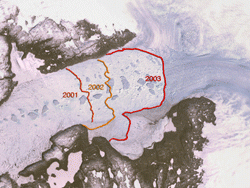
A NASA-funded study found the world's fastest glacier, Greenland's Jakobshavn Isbrae, doubled its speed of ice flow between 1997 and 2003. The study provides key evidence of newly discovered relationships between ice sheets, sea level rise and climate warming. The study appears in this week's issue of the journal Nature.
Jakobshavn Isbrae is Greenland's largest outlet glacier, draining 6.5 percent of Greenland's ice sheet area. The stream's near-doubling of ice flow from land into the ocean is important, because this one glacier has increased the rate of sea level rise by approximately four percent of the 20th century rate of increase.

The study used data from satellites and airborne lasers to derive ice movements. Synthetic aperture radar from Canada's RADARSAT and the European Space Agency's European Remote Sensing Satellites' data was used to measure the glacier's velocity. Researchers tracked distinct features in NASA Landsat satellite image pairs to determine velocities.

"Other glaciers have thinned by over a meter a year, which we believe is too much to be attributed to melting alone," said Waleed Abdalati, a senior scientist at NASA's Goddard Space Flight Center, Greenbelt, Md., and co-author of the study. "We think there is a dynamic effect in which the glaciers are accelerating due to warming. This investigation furthers our understanding of ice-climate interactions of planetary systems."

Source: NASA

Explore further: Engineering students develop a super 'space stethoscope'

add to favorites email to friend print save as pdf

Related Stories

NASA begins new season of Arctic ice science flights

Mar 21, 2013

(Phys.org) —NASA's Operation IceBridge scientists have begun another season of research activity over Arctic ice sheets and sea ice with the first of a series of science flights from Greenland completed ...

Antarctic rift subject of international attention

Oct 16, 2012

As NASA's Operation IceBridge resumed Antarctic science flights on Oct. 12, 2012, researchers worldwide had their eyes on Antarctica's Pine Island Glacier ice shelf, the site of a large rift measured during ...

Manhattan-sized ice island heads out to sea

Sep 18, 2012

Remember that enormous slab of ice that broke off Greenland's Petermann Glacier back in July? It's now on its way out to sea, a little bit smaller than it was a couple of months ago—but not much. At aro ...

New satellite data on melting of Himalayan glaciers

Aug 24, 2012

(Phys.org)—There is consensus among scientists that the glaciers in the Himalayas and Tibet are shrinking, but there is disagreement on the extent of the shrinkage because of the difficulty in interpreting ...

Recommended for you

Forecast for Titan: Wild weather could be ahead

6 hours ago

(Phys.org) —Saturn's moon Titan might be in for some wild weather as it heads into its spring and summer, if two new models are correct. Scientists think that as the seasons change in Titan's northern hemisphere, ...

NASA's Landsat satellite looks for a cloud-free view

6 hours ago

For decades, Landsat satellites have documented the desiccation of the Aral Sea in Central Asia. Once one of the largest seas in the world, it shrunk to a tenth of its original volume after Russia diverted ...

SDO observes mid-level solar flare

6 hours ago

UPDATE 16:30 p.m. EDT: The M7-class flare was also associated with a coronal mass ejection or CME, another solar phenomenon that can send billions of tons of particles into space. While this CME was not Ea ...

User comments : 0

More news stories

Forecast for Titan: Wild weather could be ahead

(Phys.org) —Saturn's moon Titan might be in for some wild weather as it heads into its spring and summer, if two new models are correct. Scientists think that as the seasons change in Titan's northern hemisphere, ...

Theorists weigh in on where to hunt dark matter

(Phys.org) —Now that it looks like the hunt for the Higgs boson is over, particles of dark matter are at the top of the physics "Most Wanted" list. Dozens of experiments have been searching for them, but ...