MARRIAGE OF CARBON NANOTUBES, LEDS SHOWS UNEXPECTEDLY BRIGHT PROSPECTS
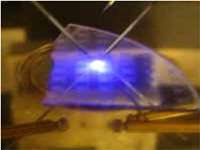
Carbon nanotubes, tiny cylinders whose extraordinary electrical and mechanical properties have spurred much excitement in recent years, may play an unexpected role in replacing the century-old incandescent light bulb.
A team of physicists and engineers at the University of Florida has shown that thin sheets or ''films'' made of carbon nanotubes are remarkably effective transmitters of electricity into light emitting diodes, or LEDs. This appears to overcome one of several obstacles to inexpensive mass production of white LEDs, which are widely viewed as replacement candidates for energy-hogging and shorter-lived incandescent and fluorescent bulbs in offices and homes today.
“There were reasons to think the nanotube films could help, but materials physics is complex, and things often don’t go the way you anticipate,” said Steve Pearton, a professor of materials science and engineering and one of the paper’s six authors. “We’re very happy to have been right in this case.”
A paper about the development - apparently the first merger of the vanguard technologies of carbon nanotubes and LEDs - appears in the most recent edition of the journal Nano Letters.
Andrew Rinzler, an associate professor of physics and a co-author, said the results suggest that carbon nanotube films could also be used to eliminate or reduce the electrical contact barrier between metals and other, untapped semiconductors - an obstacle that has stymied efforts to use promising new semiconducting materials.
Overcoming that limitation, he said, “will mean that new materials become available for microelectronics that were not previously available,” potentially leading to faster, smaller and more energy-efficient computer chips, for example.
Conventional and fluorescent lights work by heating filaments white hot and exciting light-producing gases, respectively. LEDs are semiconductors that produce light through the recombination of electrons and “holes,” or the absence of electrons. LEDs not only use less electricity than conventional lights, they also produce less heat, which extends their lifespan.
The differences can be dramatic: Some LEDs are 90 percent more efficient and last 10 times longer than their conventional counterparts, Pearton said.
Colored LEDs are becoming increasingly common commercially. Because of the significant power savings to cities, colored LEDs light many traffic signals, for example. Red, blue and yellow LEDs dominate lighting in electronics, such as digital watches, and these diodes are increasingly replacing traditional lights in automobiles. For example, because they light up faster than conventional bulbs, LED-equipped brake lights are superior for preventing crashes, Pearton said.
“The next big frontier is room lighting, or white lighting,” he said.
There are two current techniques to make white light-emitting LEDs. One is to combine red, blue and yellow LEDS to produce white light, while the other is to coat blue or ultraviolet LEDs with a phosphor, a chemical that changes the light to white.
In order for white LEDs to replace ubiquitous and super-cheap incandescent and florescent bulbs, however, the price must drop dramatically, which means LEDs must become more efficient and less expensive to manufacture, Pearton said.
The UF team’s nanotube film results are a step toward both goals, he said.
A major problem with present-day LEDs is that the side of the semiconductor with holes must be coupled to a metal that injects the light-producing current. Resistive barriers naturally arise at that metal-semiconductor junction. Although superior to conventional technology, that resistance causes LEDs to heat, wasting energy and shortening their lifespan.
The UF researchers replaced the resistant metal with a carbon nanotube film made by methods developed in Rinzler’s laboratory. Carbon nanotubes are very strong, electrically conducting cylinders with diameters measured in nanometers. A nanometer is one billionth of a meter.
To the researchers’ delight, their experiments showed the nanotube films had about one-third of the resistance of the industry standard metals in getting the current where needed. That’s an important improvement because it means LEDs will produce more light with significantly less power consumption, which also increases their useful lives, Rinzler said.
“It’s one step toward getting it to the point where this technology is cost effective and robust and all that important stuff,” Pearton said.
Michael Strano, an assistant professor of chemical and bimolecular engineering at the University of Illinois in Urbana-Champaign, had similar thoughts.
“What limits the application of these materials is the contact lifetime and robustness. Professor Rinzler has shown that the nanotube films offer a unique and fairly elegant solution to the problem,” he said, adding that the films are also valuable because they can be modified using already established semiconductor manufacturing techniques.
At $14,000 per ounce on the commercial market, nanotubes are expensive, Rinzler said. But as with carbon fibers, which four decades ago were almost prohibitively costly, once the tubes make the transformation from a scientific material to an industrial commodity, they will become cheap and readily available.
“The LED application could help spur that industrialization. This begins to use nanotubes as a bulk material,” he said.
The original news release can be found here.


