No such thing as a 'born leader,' study in fish finds
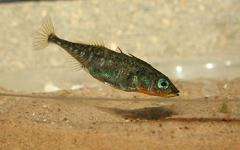
Followers are just as important to good leadership as are the leaders themselves, reveals a new study of stickleback fish published online on January 29th in Current Biology, a Cell Press publication.
By randomly pairing fish of varying degrees of "boldness," the researchers showed that each member of a pair adopts the role of leader or follower. More importantly, they found, the behavior of each member of the pair is strongly influenced by its partner.
" Our study shows that the process by which leaders and followers emerge is a dynamic one," said Andrea Manica of the University of Cambridge. "Individuals aren't simply born leaders or followers, but their role in a pair—and, we could speculate, in a larger group—is the result of social feedback where everyone plays a role."
In many animal groups, certain individuals consistently appear at the forefront of coordinated movements, the researchers explained. But exactly how those leaders are chosen has been poorly understood.
In the new study, the researchers studied the behaviors of individual stickleback fish to establish their willingness to leave the cover of some weeds to enter "riskier" waters in search of food, an indication of how bold or shy they tend to be. Those fish were then randomly paired with one another to see which of the two would emerge as the natural leader.
When paired, both the bolder and the shyer of the two fish made more food-gathering trips together and stayed out for longer periods of time. Most of the time, those forays were initiated by whichever of the two fish had independently been shown to behave more boldly.
The findings show that leadership arises from individual differences in the way that fish respond to their partner's movements, they report, a phenomenon they refer to as social feedback.
"If a shy individual is paired with a very bold individual, the latter 'inspires' the former into becoming a very faithful follower," Manica said. "Conversely, a very shy individual seems to bring out the leadership of the bolder companion, which becomes a much stronger leader than if it was paired with a less shy companion."
The results show that leadership is a matter of what one might consider personality, he added. Surprisingly—or perhaps not so surprisingly—though, the personality of the leader is not all important.
Source: Cell Press


