Research uncovers surprising lion stronghold in war-torn central Africa
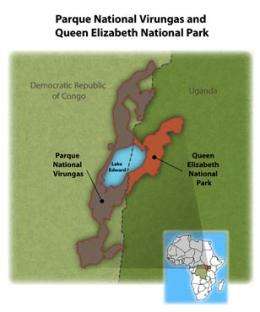
(PhysOrg.com) -- Times are tough for wildlife living at the frontier between Uganda and the Democratic Republic of the Congo. Armies are reportedly encamped in a national park and wildlife preserve on the Congolese side, while displaced herders and their cattle have settled in an adjoining Ugandan park.
And yet, the profusion of prey in the region could potentially support more than 900 individuals of the emblematic African lion, according to new research - but only if immediate conservation steps are taken.
"Those two protected areas that straddle the frontier could be the stronghold for lions in central Africa - the largest population," says University of Wisconsin-Madison environmental studies professor Adrian Treves, the study's lead author. "Therefore, (the population) is critically important, because the lion is now considered threatened throughout Africa."
He and fellow researchers from the Wildlife Conservation Society and the Panthera Foundation report their findings in the January issue of the journal Oryx, which published online today (Jan. 29).
While the conflict raging in D.R. Congo makes conservation efforts in that country's Parque National Virungas (PNVi) nearly impossible right now, says Treves, action can be taken in Uganda's Queen Elizabeth National Park (QENP). In an attempt to protect their livestock, cattlemen there have reportedly poisoned and shot predators in large numbers, stirring fears that the king of beasts may be driven to extinction in Uganda.
But these pastoralists haven't traditionally killed lions, and Treves believes they can be convinced to coexist with the cats once more if given the appropriate incentives. News of the sizeable lion population that QENP might sustain should also be brought to the Ugandan government, he adds.
"We're providing a vision of what could be," he says. "Uganda could maybe have a third of those 900-plus lions, and they're an incredible source of tourism revenue. So we're hoping that's an incentive the government will respond to."
The northern Albertine Rift, in which the two parks sit, is one of the richest reserves of biodiversity in the world. It's also home to many charismatic wildlife species, including elephant, great herds of ungulates, and lion. But how many lions is poorly known, because the area's intense poverty and strife have made it dangerous to carry out ground surveys of the cats, which can't be easily spotted from the air.
What can be readily seen and counted from planes, though, is the lion's prey. Thus, Treves and his colleagues rounded up data from aerial surveys of buffalo, warthog, waterbuck and other ungulates, and plugged it into a model that uses prey numbers and size to predict the abundance of lions. Because ground surveys of the cats were conducted in QENP in 1999 and 2004, the researchers were also able to confirm that their predictions for the Ugandan park matched well with actual lion numbers.
PNVi consistently held four to five times less prey than QENP - presumably due to poaching and habitat loss - suggesting it can currently support fewer lions. Still, the researchers expect that if prey abundance rebounds and the Congolese park can sustain similar densities of lions as its Uganda counterpart, the entire region could hold up to 905 of the cats.
But actual lion abundance in QENP also revealed a disturbing trend: A 50 percent decline between 1999 and 2004, even though prey numbers rose by 7 percent over the same period. And if lions disappear, as some are forecasting, the entire ecosystem could be in peril, says Treves. Past research shows that loss of a top predator can trigger a cascade of unpredictable changes and completely transform the system.
Still, he's optimistic this won't come to pass, so long as immediate conservation interventions are taken. He hopes the paper will serve as a call to action.
"I don't want to see lions disappear from Queen Elizabeth National Park the way that hyenas almost did, and the way cheetahs were eliminated from parts of Uganda," he says. "That's a fate we need to avoid."
Provided by University of Wisconsin-Madison


