Big cats, wild pigs and short-eared dogs -- oh, my!
Jan 27, 2009
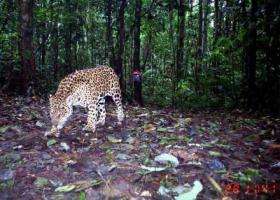
A jaguar recently captured in a camera trap in Ecuador. Credit: Santiago Espinosa

The Wildlife Conservation Society (WCS) released photos today from the first large-scale census of jaguars in the Amazon region of Ecuador—one of the most biologically rich regions on the planet.

The ongoing census, which began in 2007, is working to establish baseline population numbers as oil exploration and subsequent development puts growing pressure on wildlife in Ecuador's Yasuni National Park and adjacent Waorani Ethnic Reserve. Together, these two protected areas make up some 6,500 square miles (16,800 square kilometers) of wilderness.

The research is being carried out by a team led by WCS research fellow Santiago Espinosa. Espinosa's team, which includes several members of the Waorani indigenous group, set up a complex system of "camera traps," that photograph animals remotely when they trip a sensor that detects body heat. His work is being funded by WCS, WWF, and the University of Florida.

So far the team has taken 75 pictures of jaguars, which can be individually identified through their unique pattern of spots. Other images show jaguar prey species, such as white-lipped peccaries, and other rarely seen species, including two pictures of a short-eared dog, a relative of foxes and wolves.

"The main threats to jaguars in Ecuador are habitat degradation and loss due to various human activities," said Espinosa. "Bushmeat hunting by local communities has increased due to road development that provides access to otherwise isolated areas. Additionally, people hunt bushmeat to sell commercially in local markets, rather than simply for their own consumption. There is competition for food as people hunt the same prey species as the jaguar. If the prey species disappear, the jaguar will be gone."

Espinosa's preliminary data show far fewer jaguars in more hunted areas compared to remote study sites. In his first survey at a heavily hunted site within Yasuni National Park, Espinosa identified only three individual jaguars. At his second study site in a rarely hunted and remote area, he distinguished 14 different jaguars—almost five times as many as near the populated site.

Espinosa and WCS plan to extend the jaguar camera trap surveys to other areas of Ecuador, working with local communities in both the Amazon region and along the coast where most of the forests are gone but still may provide refuge to jaguars.

Source: Wildlife Conservation Society

Explore further: S.Korean airlines ban shark fin as cargo

add to favorites email to friend print save as pdf

Related Stories

Snowden's life surrounded by spycraft

13 hours ago

In the suburbs edged by woods midway between Baltimore and the U.S. capital, residents long joked that the government spy shop next door was so ultra-secretive its initials stood for "No Such Agency." But ...

Winners and losers at this week's E3

13 hours ago

Since the first battles over "Pong" machines in local arcades four decades ago, video gamers have loved good competition. And this year's Electronic Entertainment Expo—the industry's largest annual gathering—presented ...

Europe's space truck docks with ISS

14 hours ago

A robot freighter bearing 6.6 tonnes of cargo docked with the International Space Station (ISS) on Saturday, the European Space Agency (ESA) said.

Secret to Prism program: Even bigger data seizure

14 hours ago

In the months and early years after the Sept. 11, 2001, terrorist attacks, FBI agents began showing up at Microsoft Corp. more frequently than before, armed with court orders demanding information on customers.

Recommended for you

Have you had your cereal today?

11 minutes ago

Cereals are grasses that produce grains, the bulk of our food supply. Carnegie's Plant Biology Department is releasing genome-wide metabolic complements of several cereals including rice, barley, sorghum, and millet. Along ...

How do bees make honey? It's not just bee barf

46 minutes ago

(Phys.org) —Last weekend, my daughter asked me how bees made honey, and I realized that I didn't know the answer. How do bees make honey? I did some homework, and can now explain it to her – and to you.

S.Korean airlines ban shark fin as cargo

1 hour ago

South Korea's two largest airlines, Korean Air and Asiana, said Thursday they had both decided to ban shark fin from their cargo flights as part of a growing global campaign against the Asian delicacy.

Biological fitness trumps other traits in mating game

12 hours ago

When a new species emerges following adaptive changes to its local environment, the process of choosing a mate can help protect the new species' genetic identity and increase the likelihood of its survival. ...

User comments : 0

More news stories

How do bees make honey? It's not just bee barf

(Phys.org) —Last weekend, my daughter asked me how bees made honey, and I realized that I didn't know the answer. How do bees make honey? I did some homework, and can now explain it to her – and to you.

S.Korean airlines ban shark fin as cargo

South Korea's two largest airlines, Korean Air and Asiana, said Thursday they had both decided to ban shark fin from their cargo flights as part of a growing global campaign against the Asian delicacy.

Dusty surprise around giant black hole

(Phys.org) —ESO's Very Large Telescope Interferometer has gathered the most detailed observations ever of the dust around the huge black hole at the centre of an active galaxy. Rather than finding all of ...