Study shows effect of feral buffalo on Kakadu
Jan 13, 2009
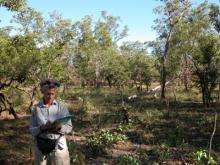
Dr Lynda Prior recording data on tree cover in the savanna at the Buffalo Farm.

The ecological effect of feral buffalo on Kakadu National Park has been the focus of a research study by a team of prominent Charles Darwin University researchers.

Research fellow with CDU’s School for Environmental Research (SER), Dr Lynda Prior, Adjunct Professor SER, Professor David Bowman, Lecturer Geographical Information Systems, Dr Guy Boggs and SER PhD candidate, Caroline Lehmann, recently published their ground-breaking paper in the Journal of Biogeography.

The study investigated the changes in woody vegetation in both floodplains and eucalypt savanna over a 40-year period using spatial analysis of variation in density of feral buffalo in Kakadu National Park.

Dr Prior said the study revealed that although the density of woody vegetation on the floodplain had increased during the 40-year study period, buffalo were not the major cause.

“The correlation between the densities of feral buffalo and the prevalence of woody cover in Kakadu National Park was weak,” she said.

“Rather, the observed increases in woody cover in both savanna and flood plains concords with regional trends and may be related to an increased level of atmospheric CO2, increasing rainfall and changing fire regimes during the study period.”

Professor Bowman said that feral buffalo built up to high densities in Kakadu until 1985, after which a control program almost eliminated the animals.

“In 1990, a buffalo farm was established within Kakadu National Park to supply meat to traditional owners, to compensate for the loss of the wild buffalo,” he said.

“However, these buffalo were at much lower densities than the feral buffalo had been, and were managed to minimise environmental impacts.

“Our study compared trends in woody vegetation when buffalo were high-density feral, low-density managed or absent.”

The study analysed sequences of digitised and geo-rectified aerial photographs acquired from dates up to 2004 to chart changes in woody cover on the floodplain and in the savanna.

Provided by Charles Darwin University

Explore further: GPS, camera traps and dung expose the secret life of endangered elephants (w/ Video)

add to favorites email to friend print save as pdf

Related Stories

Buffaloes a divisive link to Hong Kong's past

Feb 18, 2013

A short journey from the skyscrapers at the hectic centre of Hong Kong, water buffaloes lumber over jungle-clad hills and through secluded villages where they once worked as farm animals.

Killing in the name of conservation

Feb 22, 2010

Thanks to the introduction of various non-native species to Australia throughout history, the country is overrun with feral animals. A new application developed by ecologists at the University of Adelaide to be published ...

Recommended for you

Researcher admits mistakes in stem cell study

7 hours ago

A blockbuster study in which US researchers reported that they had turned human skin cells into embryonic stem cells contained errors, its lead author has acknowledged. ...

Scientists discover how rapamycin slows cell growth

9 hours ago

University of Montreal researchers have discovered a novel molecular mechanism that can potentially slow the progression of some cancers and other diseases of abnormal growth. In the May 23 edition of the prestigious journal ...

Bittersweet: Bait-averse cockroaches shudder at sugar

11 hours ago

Sugar isn't always sweet to German cockroaches, especially to the ones that avoid roach baits. In a study published May 24 in the journal Science, North Carolina State University entomologists show the ne ...

User comments : 0

More news stories

White tiger mystery solved

White tigers today are only seen in zoos, but they belong in nature, say researchers reporting new evidence about what makes those tigers white. Their spectacular white coats are produced by a single change ...

Controlling mood through the motions of mitochondria

(Medical Xpress)—Regulating the distribution of power in neurons is done by a system that makes the national electric grid look simple by comparison. Each neuron has several thousand mitochondria confined ...