Giant bird feces records pre-human New Zealand
Jan 12, 2009
Giant bird feces records pre-human New Zealand
Giant moa bird. Image courtesy iStockphoto.

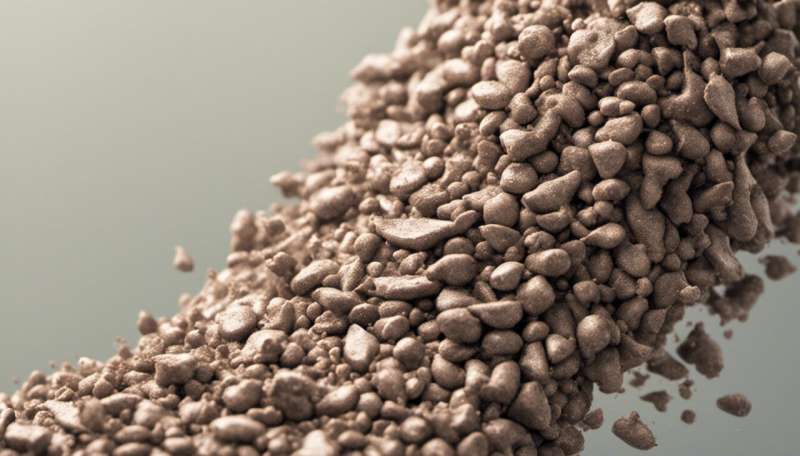
(PhysOrg.com) -- A treasure trove of information about pre-human New Zealand has been found in faeces from giant extinct birds, buried beneath the floor of caves and rock shelters for thousands of years.

A team of ancient DNA and palaeontology researchers from the University of Adelaide, University of Otago and the NZ Department of Conservation have published their analyses of plant seeds, leaf fragments and DNA from the dried faeces (coprolites) to start building the first detailed picture of an ecosystem dominated by giant extinct species.

Former PhD student Jamie Wood, from the University of Otago, discovered more than 1500 coprolites in remote areas across southern New Zealand, primarily from species of the extinct giant moa, which ranged up to 250 kilograms and three metres in height. Some of the faeces recovered were up to 15 centimetres in length.

'"Surprisingly for such large birds, over half the plants we detected in the faeces were under 30 centimetres in height," says Dr Wood. "This suggests that some moa grazed on tiny herbs, in contrast to the current view of them as mainly shrub and tree browsers. We also found many plant species that are currently threatened or rare, suggesting that the extinction of the moa has impacted their ability to reproduce or disperse."

"New Zealand offers a unique chance to reconstruct how a 'megafaunal ecosystem' functioned," says Professor Alan Cooper, Director of the Australian Centre for Ancient DNA, which performed the DNA typing.

"You can't do this elsewhere in the world because the giant species became extinct too long ago, so you don't get such a diverse record of species and habitats. Critically, the interactions between animals and plants we see in the poo provides key information about the origins and background to our current environment, and predicting how it will respond to future climate change and extinctions."

"When animals shelter in caves and rock shelters, they leave faeces which can survive for thousands of years if dried out," Professor Cooper says. "Given the arid conditions, Australia should probably have similar deposits from the extinct giant marsupials. A key question for us is 'where has all the Australian poo gone?' ".

The team's findings have recently been published in Quaternary Science Reviews, an international geological research journal.

Journal: www.elsevier.com/wps/find/journaldescription.cws_home/636/description#description

Provided by University of Adelaide

Explore further: City-life changes blackbird personalities, study shows

add to favorites email to friend print save as pdf

Related Stories

Beyond NYC: Other places adapting to climate, too

25 minutes ago

From Bangkok to Miami, cities and coastal areas across the globe are already building or planning defenses to protect millions of people and key infrastructure from more powerful storm surges and other effects ...

China paper hits out at US surveillance programme

35 minutes ago

China's official army newspaper on Sunday branded the United States Internet surveillance programme exposed by former spy Edward Snowden as "frightening", and accused the US of being a "habitual offender" ...

German spy service plans 'more online surveillance'

45 minutes ago

Germany's foreign intelligence service plans a major expansion of Internet surveillance despite deep unease over revelations of US online spying, Der Spiegel news weekly reported on Sunday.

Russia fetes 50th anniversary of first woman in space

55 minutes ago

Russia celebrated Sunday the 50th anniversary of the maiden flight of the first woman in space—a Soviet national hero who went by the call name "Seagull" and captured the imaginations of girls around the ...

Current, former officials back secret surveillance

1 hour ago

Current and former top U.S. officials on Sunday defended the government's collection of phone and Internet data following new revelations about the secret surveillance programs, saying the operations were ...

Recommended for you

City-life changes blackbird personalities, study shows

7 hours ago

The origins of a young animal might have a significant impact on its behavior later on in life. Researchers at the Max Planck Institute for Ornithology in Radolfzell, Germany, have been able to demonstrate ...

Origins of 'The Hoff' crab revealed (w/ Video)

7 hours ago

The history of a new type of crab, nicknamed 'The Hoff' because of its hairy chest, which lives around hydrothermal vents deep beneath the Southern Ocean and Indian Ocean, has been revealed for the first ...

Personality test finds some mouse lemurs shy, others bold

12 hours ago

Anyone who has ever owned a pet will tell you that it has a unique personality. Yet only in the last 10 years has the study of animal personality started to gain ground with behavioral ecologists, said Jennifer ...

User comments : 10

Adjust slider to filter visible comments by rank

Display comments: newest first

QubitTamer
not rated yet Jan 12, 2009
Holy ancient S&#^!
WolfAtTheDoor
not rated yet Jan 12, 2009
Dear "Former PhD student Jamie Wood, from the University of Otago",

You should have studied Astrophysics, instead.
boredWithScience
5 / 5 (1) Jan 12, 2009
Come on Australia, get your S&#^! together.
Sophos
not rated yet Jan 12, 2009
Wolf if Jamie can't get a Ph.D. in poo how can he make it in Astrophysics?
Mercury_01
not rated yet Jan 12, 2009
Hey, any headline with the word feces in it is an instant winner in my book.
stirfry
not rated yet Jan 12, 2009
'where has all the Australian poo gone? - That's easy - http://www.imdb.c...0455824/
malapropism
not rated yet Jan 12, 2009
Sophos, the reference to Jamie Wood being a "former Ph.D student" does not indicate that s/he failed to gain a Doctorate, indeed, the immediately following paragraph refers to him/her as "Dr Wood". ("Jamie" is not necessarily exclusively a male name.)
Commentateur
2.3 / 5 (3) Jan 12, 2009
Endangered Feces would seem to be a logical consequence, or at least an "end" result, of Endangered Species.
WolfAtTheDoor
not rated yet Jan 13, 2009
'where has all the Australian poo gone? - That's easy - http://www.imdb.c...0455824/

*high five*
AMMBD
1 / 5 (1) Jan 20, 2009
Endangered Feces would seem to be a logical consequence, or at least an "end" result, of Endangered Species.


rotflmao. so needed that laugh on a monday. thx!

More news stories

Origins of 'The Hoff' crab revealed (w/ Video)

The history of a new type of crab, nicknamed 'The Hoff' because of its hairy chest, which lives around hydrothermal vents deep beneath the Southern Ocean and Indian Ocean, has been revealed for the first ...

3D printing tiny batteries

(Phys.org) —3D printing can now be used to print lithium-ion microbatteries the size of a grain of sand. The printed microbatteries could supply electricity to tiny devices in fields from medicine to communications, ...