Bees attracted by floral iridescence
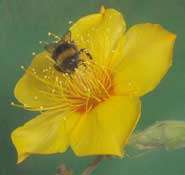
(PhysOrg.com) -- Plants and their pollinators are the focus of ground-breaking research by Dr Heather Whitney, recently appointed Lloyds Fellow in the School of Biological Sciences. Her latest work, carried out at the University of Cambridge and published this month in Science, showed for the first time that bees see some flowers in multi-colour because of previously unknown iridescence of the petals.
Iridescence, the optical phenomenon whereby a surface appears in different colours depending on the angle from which it is viewed, is used by insects, birds, fish, and reptiles for species recognition and mate selection.
Although iridescence might be expected to increase a flower’s attractiveness, it might also compromise identification, because the flower’s appearance will vary depending on the viewer’s perspective. We found that bumblebees (Bombus terrestris) learn to disentangle flower iridescence from colour, and correctly identify iridescent flowers despite their continuously changing appearance.
We identified iridescence in hibiscus and tulip flowers, and demonstrated that their iridescence is generated through diffraction gratings - the same physical structure that makes compact discs iridescent. Flowers were previously believed only to use chemical colours where a pigment absorbs all wavelengths except a few, giving them their apparent colour. Iridescence can only be generated structurally, not through chemical colours.
Because most of the petal iridescence measured is at the ultraviolet end of the spectrum, which insects can see but humans cannot, this raises the intriguing possibility that many flowers are actually iridescent although they do not appear so to the human eye.
Our initial survey of plants suggests that iridescence may be very widespread. From gardening to agriculture, flowers and their pollinators play an enormously important role in our daily lives, and it is intriguing to realise that they are signalling to each other with flashing multi-colours that we simply cannot see.
Paper: Floral iridescence, produced by diffractive optics, acts as a cue for animal pollinators by Heather M. Whitney, Mathias Kolle, Piers Andrew, Lars Chittka, Ullrich Steiner and Beverley J. Glover. Science 2 January 2009 323: 130-133 [DOI: 10.1126/science.1166256]
Provided by University of Bristol


