Lamin A/C deficiency is 'unnerving'
Jan 05, 2009
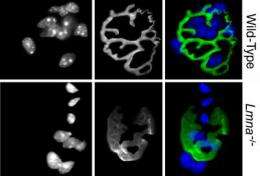
Lmna -/- animals have disorganized neuromuscular synapses (green) without postsynaptic nuclei (blue). Credit: Méjat, A., et al. 2008. J. Cell Biol.

Mutations in the nuclear intermediate filament lamin A/C (LMNA) gene are associated with Emery-Dreifuss muscular dystrophy, but cause the disease by unknown mechanisms. Méjat et al. show that one mechanism involves the disruption of neuromuscular junctions.

The study will appear online on Monday, January 5, 2009 (www.jcb.org) and in the January 12, 2009 print issue of the Journal of Cell Biology.

Muscle fiber cells contain hundreds of nuclei. In normal fibers, several nuclei cluster together under the cell membrane at sites of neuronal contact. These postsynaptic nuclei synthesize the components of the neuromuscular junction that specify the overlying membrane as the target site for innervation. The authors found that LMNA-deficient animals (including those with a point mutation in LMNA that in humans can cause Emery-Dreifuss disease) failed to position nuclei into these postsynaptic clusters. This prevented the proper organization of the neuromuscular junction and disrupted muscle fiber innervation, says author Alexandre Méjat.

The authors showed that either loss or mutation of LMNA disrupted nuclear positioning by causing the mislocalization of two other proteins: Nesprin-1, which spans the outer nuclear membrane and anchors nuclei to the actin cytoskeleton, and SUN2, which spans the inner nuclear membrane, linking Nesprin to lamin A/C. Although lamin A/C is ubiquitously expressed, LMNA defects specifically affected striated and skeletal muscle because Nesprin-1 and SUN2 are highly expressed in these tissues. Samples from Emery-Dreifuss muscular dystrophy patients exhibit similar hallmarks of skeletal muscle functional denervation, suggesting the authors are on the right track.

Paper: Méjat, A., et al. 2008. J. Cell Biol. doi:10.1083/jcb.200811035.

Source: Rockefeller University

Explore further: Front-row seats to climate change

add to favorites email to friend print save as pdf

Related Stories

New technique enables study of 'challenging' proteins

Nov 14, 2011

Researchers from Hull, Bristol and Frankfurt have shown that a new technique for identifying molecular structure can be used effectively on small samples of biological proteins, particularly proteins that are targeted for ...

Uncovering the trail behind growing too old, too soon

Jan 24, 2011

Scientists from A*STAR's Institute of Medical Biology (IMB) in Singapore and the University of Hong Kong's Department of Medicine have produced the world's first human cell model of progeria, a disease resulting in severe ...

New characteristics of premature aging protein discovered

Nov 16, 2010

(PhysOrg.com) -- Dr. Joseph Glavy at Stevens Institute of Technology studies the smallest and most basic elements of life. The Assistant Professor of Chemical Biology runs the Glavy Lab, where advanced student ...

Immune cells deploy traps to catch and kill pathogens

Oct 25, 2010

A new study reveals that two enzymes help immune cells deploy pathogen-killing traps by unraveling and using the chromatin (DNA and its associated proteins) contained in the cells' nuclei to form defensive ...

Pore 'vision' improved

Oct 18, 2010

A team led by Naoko Imamoto of the RIKEN Advanced Science Institute in Wako, Japan, has uncovered processes governing the formation of functionally important structures called nuclear pore complexes (NPCs) ...

Recommended for you

Front-row seats to climate change

May 17, 2013

By day, insects provide the white noise of the South, but the night belongs to the amphibians. In a typical year, the Southern air hangs heavy from the humidity and the sounds of wildlife.

Climate change may have little impact on tropical lizards

May 17, 2013

A new Dartmouth College study finds human-caused climate change may have little impact on many species of tropical lizards, contradicting a host of recent studies that predict their widespread extinction in a rapidly warming ...

Wetlands: value to locals matters most

May 17, 2013

A new way of valuing ecosystem services, incorporating the local perspective, is the driving force behind a project assessing aquatic ecosystems in highland areas of Asia

User comments : 0

More news stories

Morocco to harness the wind in energy hunt

Morocco is ploughing ahead with a programme to boost wind energy production, particularly in the southern Tarfaya region, where Africa's largest wind farm is set to open in 2014.

Galaxy's Ring of Fire

Johnny Cash may have preferred this galaxy's burning ring of fire to the one he sang about falling into in his popular song. The "starburst ring" seen at center in red and yellow hues is not the product of ...