Engineers develop new way to fuse cells
Jan 04, 2009 by Anne Trafton
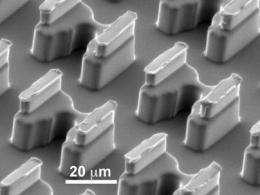
These cups on a microchip trap cells so they can be paired up and fused together. Image / Alison Skelley

MIT engineers have developed a new, highly efficient way to pair up cells so they can be fused together into a hybrid cell. The new technique should make it much easier for scientists to study what happens when two cells are combined. For example, fusing an adult cell and an embryonic stem cell allows researchers to study the genetic reprogramming that occurs in such hybrids.

The researchers, led by a collaboration between Joel Voldman, associate professor of electrical engineering and computer science, and Rudolf Jaenisch, professor of biology and a member of the Whitehead Institute, report the new technique in the Jan. 4 online edition of Nature Methods.


Above: In this video, pairs of cells that have been trapped together are fused into single hybrid cells.

The work was spearheaded by two postdoctoral associates, Alison Skelley, who worked in Voldman's lab, and Oktay Kirak, who works with Jaenisch. Skelley and Kirak are lead authors of the Nature Methods paper. Heikyung Suh, a technical associate in the Whitehead Institute, is also an author of the paper.

The team's simple but ingenious sorting method increases the rate of successful cell fusion from around 10 percent to about 50 percent, and allows thousands of cell pairings at once.

Though cell fusion techniques have been around for a long time, there are many technical limitations, said Voldman.

Getting the right cells to pair up before fusing them is one major obstacle. If scientists are working with a mixture of two cell types, for example A and B, they end up with many AA and BB pairings, as well as the desired AB match.

Researchers had previously trapped cells in tiny cups as they flow across a chip. Each cup can hold only two cells, but there is no way to control whether the cups capture an A and a B, two As or two Bs.

In contrast, the cell-trapping cups on Voldman and Jaenisch's new sorting device are arranged strategically to capture and pair up cells of different types.

First, type A cells are flowed across the chip in one direction and caught in traps that are large enough to hold only one cell. Once the cells are trapped, liquid is flowed across the chip in the opposite direction, pushing the cells out of the small cups and into larger cups across from the small ones.

Once one A cell is in each large cup, type B cells are flowed into the large cups. Each cup can only hold two cells, so each ends up with one A and one B. After the cells are paired in the traps, they can be joined together by an electric pulse that fuses the cell membranes.

In addition to helping with studies of stem cell reprogramming, this technique could be used to study interactions between any types of cells. "It's a very general type of device," said Voldman.

Source: Massachusetts Institute of Technology

Explore further: Front-row seats to climate change

add to favorites email to friend print save as pdf

Related Stories

Neural activity in bats measured in-flight

Apr 18, 2013

Animals navigate and orient themselves to survive – to find food and shelter or avoid predators, for example. Research conducted by Dr. Nachum Ulanovsky and research student Michael Yartsev of the Weizmann ...

Study proposes alternative way to explain life's complexity

Apr 12, 2013

Evolution skeptics argue that some biological structures, like the brain or the eye, are simply too complex for natural selection to explain. Biologists have proposed various ways that so-called 'irreducibly complex' structures ...

Bees get a buzz from caffeine

Mar 07, 2013

Scientists have today shown that caffeine improves a honeybee's memory and could help the plant recruit more bees to spread its pollen.

Biomass analysis tool is faster, more precise

Mar 05, 2013

A screening tool from the U.S. Department of Energy's National Renewable Energy Laboratory (NREL) eases and greatly quickens one of the thorniest tasks in the biofuels industry: determining cell wall chemistry to find plants ...

Manipulating cells with a micro-suction cup

Aug 12, 2010

Researchers at the Institute for Biomedical Engineering have devised a novel method to pick up and relocate individual cells with a microtip without damaging them. In the future this could be used to verify ...

World Cup coverage expands on the Web, cell phones

Jun 09, 2010

(AP) -- With games airing live on cell phones and computers, the World Cup will get more online coverage than any major sporting event yet. Watching highlights the next day on TV or YouTube will suddenly ...

Recommended for you

Front-row seats to climate change

May 17, 2013

By day, insects provide the white noise of the South, but the night belongs to the amphibians. In a typical year, the Southern air hangs heavy from the humidity and the sounds of wildlife.

Climate change may have little impact on tropical lizards

May 17, 2013

A new Dartmouth College study finds human-caused climate change may have little impact on many species of tropical lizards, contradicting a host of recent studies that predict their widespread extinction in a rapidly warming ...

Wetlands: value to locals matters most

May 17, 2013

A new way of valuing ecosystem services, incorporating the local perspective, is the driving force behind a project assessing aquatic ecosystems in highland areas of Asia

User comments : 2

Adjust slider to filter visible comments by rank

Display comments: newest first

NOM
not rated yet Jan 04, 2009
Vulvox has a general method of excreting several smelly types of molecule.

Stop spamming neil
Dating
not rated yet Jan 04, 2009
great study, Nice article to read. With these study a lot research for sure related to stem cell and other cell related work will come up.

http://www.univer...tion.com

More news stories

US seizes Bitcoin operator accounts

US authorities seized the accounts of a Bitcoin digital currency exchange operator, claiming it was functioning as an "unlicensed money service business," court documents showed Friday.

Morocco to harness the wind in energy hunt

Morocco is ploughing ahead with a programme to boost wind energy production, particularly in the southern Tarfaya region, where Africa's largest wind farm is set to open in 2014.